


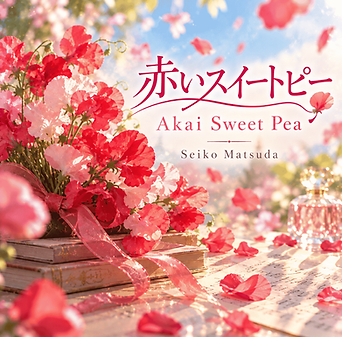
This article offers cultural and emotional commentary on selected lyric excerpts, focusing on meaning, nuance, and context rather than literal translation.
Only short excerpts are quoted for commentary purposes; full lyrics are not provided, and all rights belong to the respective rights holders.
🌷 赤いスイートピー Akai Sweet Pea by Seiko Matsuda
— Japanese Lyric Cultural & Language Room
"Akai Sweet Pea" (赤いスイートピー) by Seiko Matsuda was released as a single on January 21, 1982.The lyrics were written by Takashi Matsumoto, while the music was composed by Yumi Matsutoya — known for a string of classics dating back to her days as Yumi Arai, including "Hikoukigumo," "Chuo Freeway," and "Rouge no Dengon" — under the pen name "Karuho Kureda" (呉田軽穂). At the time, Matsutoya had already established herself as a leading figure in Japan's "New Music" scene. She is said to have agreed to provide this song only on the condition that she could use a pen name, wanting to be judged by the quality of the song itself rather than by her own name recognition. This song also became a memorable one for Matsutoya in another sense: producer Muneo Wakamatsu asked her to revise the melody so that it would rise toward the end, to match the song's spring-like feel. She later recalled, "That was the only time a song I provided was ever sent back for revisions, before or since."
More than 40 years after its release, the song remains widely loved, and has been used in a variety of settings — as an insert song in the 2013 film "Mugiko-san to," as an insert song in the TV drama "Dandan," and in commercials for a skincare product and for a condominium brand.
In this article, we explore seven culturally rich phrases from the Japanese lyrics, including their romaji pronunciation, cultural context, and linguistic nuances for English speakers. Interpretations may vary.
1. タバコの匂いのシャツに
Romaji: Tabako no nioi no shatsu ni
Cultural Nuance: "On a shirt that smells of cigarettes"
🗣 Japanese Insight: According to a survey by Japan Tobacco (JT), the smoking rate among adult men in Japan reached 70.1% in 1982. Lyricist Takashi Matsumoto himself was asked about this line on a Japanese television program, where he explained that he wrote it with that era in mind: "It was the times, really. This was the early '80s, so about seventy percent of men smoked."
He went on to say, "Some people hate the smell of cigarettes. But even a smell you'd normally dislike the most can smell good if it's someone you love wearing it." In other words, this line isn't simply describing a habit of the era — it captures the feeling of love itself, the way even an ordinarily unpleasant scent can become endearing when it belongs to someone you care about.
2. あなたって手も握らない
Romaji: Anata tte te mo nigiranai
Cultural Nuance: "Honestly, you won't even hold my hand"
🗣 Japanese Insight: The "tte" in "anata tte" (あなたって) is a colloquial particle often used in spoken Japanese. It carries a nuance similar to "when it comes to you" or "you, of all people," lightly calling attention to someone's character or behavior. It sounds more conversational and emotionally expressive than the neutral "anata wa" (あなたは), and in this context it reinforces the sense of familiarity between the two.
This light complaint—that even after half a year together, he still hasn't held her hand—carries a feeling closer to gentle frustration and affectionate longing than actual anger. In this short phrase alone, we can sense the relationship between a shy, reserved boyfriend and a narrator who finds him a little exasperating, yet accepts him as he is.
3. I will follow you ちょっぴり気が弱いけど
Romaji: I will follow you choppiri ki ga yowai kedo
Cultural Nuance: "You're a little timid, but I want to follow you just as you are"
🗣 Japanese Insight: "Ki ga yowai" (気が弱い) is an idiomatic expression combining "ki" (気, meaning heart or spirit) and "yowai" (弱い, weak), meaning "timid" or "easily intimidated."
The subject of "ki ga yowai" is not stated explicitly, but given the surrounding lines—"anata tte te mo nigiranai" (you won't even hold my hand) just before, and "suteki na hito dakara" (because you're wonderful) just after—it is understood to describe him, not the narrator herself. Rather than blaming him for being too reserved to hold her hand, she softens it with the gentle word "choppiri" (a little), and still expresses her desire to follow him because she sees him as a wonderful person—a quiet but resolute expression of affection.
4. 心の岸辺に咲いた 赤いスイートピー
Romaji: Kokoro no kishibe ni saita akai suīto pī
Cultural Nuance: "A red sweet pea blooming on the shore of my heart"
🗣 Japanese Insight: Lyricist Takashi Matsumoto has said he conceived this song as a love song built around the theme of "love" itself. In his own words, "Love means there's a man and a woman, and something like a river runs between them. A red sweet pea blooms on the bank of that river. A river flows through everyone's heart, and that's what love is." True to this explanation, the word "kishibe" (岸辺, shore/riverbank) functions as a metaphor for the distance and shifting emotions between two people in love.
According to Matsumoto, red sweet peas did not actually exist in 1982, and he only learned this after the song's release, when someone told him, "there's no such color." Even so, as the lyrics describe, this red is depicted as a flower blooming within the image of the "shore of one's heart." Matsumoto has also recalled that after the song became a huge hit, flower growers developed a red variety of sweet pea through breeding, and red sweet peas are now genuinely sold today.
5. あなたが時計をチラッと見るたび
Romaji: Anata ga tokei o chiratto miru tabi
Cultural Nuance: "Every time you glance at your watch"
🗣 Japanese Insight: "Chiratto" (チラッと) is a mimetic word (onomatopoeia) describing a brief, momentary glance. Japanese has many words that finely distinguish different kinds of gazes, such as "jitto miru" (to stare fixedly) or "chirachira miru" (to glance repeatedly), and "chiratto" stands out among them as especially short and casual, capturing just a single fleeting motion.
Lyricist Takashi Matsumoto has explained this line on a Japanese television program: "Glancing at the clock means he has somewhere to be next. She wants to stay together forever, but he's mindful of the time, mindful of when he has to head home." He has said that it's this small mismatch between her, wanting to stay together, and him, keeping track of the time, that gives this moment its quiet sadness.
6. I will follow you 翼の生えたブーツで
Romaji: I will follow you tsubasa no haeta būtsu de
Cultural Nuance: "I want to follow you in boots that have sprouted wings"
🗣 Japanese Insight: "Wings sprouting from boots" is a metaphor built around an item that doesn't exist in reality. "Haeru" (生える, to sprout/grow) is normally a verb used for things that naturally grow on living beings—hair, teeth, plants, or the wings of a bird or angel. By attaching this verb to "boots," an object with no life of its own, the lyrics create a fantastical, weightless image of "boots that have sprouted wings," something impossible in the real world. By giving wings to boots—footwear normally associated with walking on the ground—the lyric gives her wish to follow him a light, fantastical quality.
For English-speaking readers, this idea of "winged footwear" might call to mind the winged sandals worn by Hermes, the messenger god of Greek mythology. The lyrics themselves make no direct reference to Greek mythology, but the fact that they can evoke such an association is part of what makes this metaphor so engaging.
7. 心に春が来た日は 赤いスイートピー
Romaji: Kokoro ni haru ga kita hi wa akai suīto pī
Cultural Nuance: "On the day spring came to my heart, a red sweet pea"
🗣 Japanese Insight: "Kokoro ni haru ga kuru" (心に春が来る, "spring comes to one's heart") is a metaphorical expression that associates the arrival of spring with the excitement and happiness of love. Japanese poetry and song lyrics frequently link the changing of the seasons to shifts in emotion, and this phrase carries on that traditional sensibility.
"Akai suīto pī" (赤いスイートピー), repeated here as the closing line of the chorus, depicts the same inner landscape as the flower "blooming on the shore of my heart" in phrase 4. Yet here, the addition of "the day spring came" suggests that her uncertain, wavering feelings have begun to brighten, like the arrival of spring. The song is structured so that the emotion that has grown little by little throughout is drawn together, once more, into the single phrase "akai suīto pī."
🎤 Emotional Summary
"Akai Sweet Pea" is a love song about a narrator who cares for a boyfriend who still has not held her hand after half a year together. She feels a certain tenderness toward him and the scent of cigarettes he carries, precisely because he's the one she loves, even as she feels a mix of frustration and longing toward him for being too timid to take that first step. Every time he glances at his watch, a small gap opens up between his awareness of what comes next and her wish to stay together forever, and even within that quiet sadness, she keeps singing her honest feeling, "I will follow you." The red sweet pea, a flower that didn't actually exist at the time, is an imagined flower that gives shape to a love not yet fully formed, and the same flower "blooming on the shore of her heart" reappears at the song's end alongside the phrase "the day spring came to my heart," now as a hopeful, joyful change of heart. With careful, delicate word choice, the song captures a very real, relatable kind of love — for a shy boyfriend, and for a narrator who wants to follow him all the same.
📚 Sources & References
Health and Welfare Foundation, "National Smoking Rate Survey" (JT data)
Takashi Matsumoto interviews (Real Sound / Asahi Shimbun column / coconuts japan)
Article on the making of "Akai Sweet Pea" by Seiko Matsuda (tapthepop.net)
News coverage of the film "Mugiko-san to" (eiga.com)
Background material on the NHK drama "Dandan"
🔍 Related Articles
🌊 青い珊瑚礁 Aoi Sangoshō - Blue Lagoon by Seiko Matsuda
🧜♀️ 小麦色のマーメイド Komugiiro no Mermaid by Seiko Matsuda
🦪✨ 真珠のピアス Pearl Pierce by Yumi Matsutoya (Yumi Arai)
📝 Q&A for "Akai Sweet Pea" (赤いスイートピー) by Seiko Matsuda
🌺 Q1. What is the cultural meaning behind the tobacco scent and hand-holding in Seiko Matsuda’s "Akai Sweet Pea"?
A: In 1982, when "Akai Sweet Pea" was released, male smoking in Japan was extremely common (over 70%), symbolizing an adult image. The contrast between the boyfriend's tobacco scent and his hesitation to hold hands highlights a tender, innocent romance between a shy young couple, creating a sense of affectionate longing.
🎨 Q2. Is it true that red sweet peas didn't exist when Takashi Matsumoto wrote "Akai Sweet Pea"?
A: Yes! Lyricist Takashi Matsumoto wrote "Akai Sweet Pea" as a metaphor for love blooming on the shore of one's heart, unaware that red sweet peas didn't actually exist in nature in 1982. However, due to the song's massive popularity, flower growers eventually bred real red sweet peas.
🎼 Q3. Who composed Seiko Matsuda’s "Akai Sweet Pea," and what is the story behind its composition?
A: The song was composed by legendary Japanese singer-songwriter Yumi Matsutoya under the pen name "Karuho Kureda." She agreed to write it under a pseudonym to be judged purely on music quality. Producer Muneo Wakamatsu asked her to revise the melody to rise toward the end to fit a spring-like feel—making it the only song Matsutoya was ever asked to revise.
📘 Notes on Cultural & Emotional Context
This section explores selected phrases from the song to highlight their emotional nuance and cultural background within Japanese music and storytelling.
Rather than presenting a word-for-word translation, the focus is on how these expressions convey feeling, atmosphere, and narrative meaning.
The insights are intended for readers interested in Japanese songs, anime, and culture, offering interpretive context rather than formal language instruction.
📜 Disclaimer
This article provides cultural and emotional commentary on selected lyric excerpts for informational purposes.
Only short excerpts are quoted for commentary; full lyrics are not provided.
All rights belong to the respective rights holders, and no ownership is claimed.
Advertisements or affiliate links may appear to support the site.
If you enjoyed this article, feel free to leave a comment below👇
You’re also welcome to share your thoughts or request songs you’d like us to explore in the future😊