


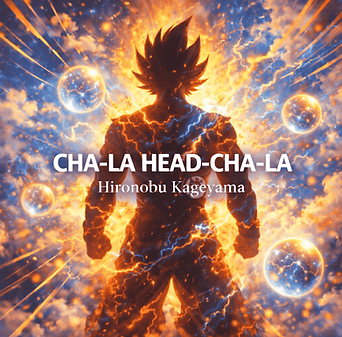
This article offers cultural and emotional commentary on selected lyric excerpts, focusing on meaning, nuance, and context rather than literal translation.
Only short excerpts are quoted for commentary purposes; full lyrics are not provided, and all rights belong to the respective rights holders.
🐉 CHA-LA HEAD-CHA-LA by Hironobu Kageyama
— Japanese Lyric Cultural & Language Room —
Released on May 1, 1989, "CHA-LA HEAD-CHA-LA" served as the legendary first opening theme for the anime Dragon Ball Z. For over four years, it resonated in living rooms across Japan every single week, becoming an inseparable part of the childhood experience for an entire generation. This song has completely transcended the framework of a mere "anime song" to become a universal password and a cultural anthem symbolizing Japanese pop culture on a global scale.
The vocals are performed by Hironobu Kageyama, who originally rose to fame as the vocalist of the rock band "LAZY." This song solidified his status as the "Prince of Anime Songs." Kageyama’s high-toned, energetic, and piercing vocals perfectly capture the essence of Son Goku: a combination of planet-shaking strength and a heart that is bottomlessly cheerful and pure.
The lyrics were penned by Yukinojo Mori, a visionary lyricist known for his experimental approach. In crafting this piece, Mori tapped into the "punk spirit" of Goku—the defiant ability to laugh off any hardship. The title's "CHA-LA" comes from the Japanese word chara, which is often used to mean "to reset to zero" or "to balance the books." Meanwhile, "HEAD-CHA-LA" is a play on hetchara, meaning "I'm okay" or "it's no big deal." By linking these two through their rhythmic sound, the song creates a sense of positive energy—suggesting that by shaking off the shackles of the past, one can embark on a new adventure. Furthermore, the English spelling of "HEAD" in "HEAD-CHA-LA" reflects Mori’s philosophy: by "resetting your HEAD" (emptying your mind), you create infinite space to pack in new dreams.
In this article, we explore seven key phrases from the Japanese lyrics, including their romaji pronunciation and deeper cultural meaning. Below are seven culturally rich lyric expressions, explained with linguistic nuance for English speakers to appreciate the true depth of this legendary anthem.
1. からだじゅうに 広がるパノラマ
Romaji: karadajū ni / hirogaru panorama
Cultural Nuance: A magnificent landscape spreading throughout every single cell of your entire body.
🗣 Japanese Insight: The term "Karadajū" (からだじゅう) translates to "the entire body," but it carries a deeper nuance that includes everything from individual cells to the very tips of one's fingers. When Goku soars through the vast sky on his Flying Nimbus (Kinto-un), he isn't just "watching" the scenery visually. Instead, he is feeling the wind against his skin, bathing in the sunlight, and "absorbing freedom through his entire physical being." This use of "panorama" combined with "karadajū" encapsulates a wild, dynamic sense of primal happiness typical of Dragon Ball. It describes a state of liberation where one enjoys an adventure not through logic or thought, but by releasing all life senses and harmonizing with the world.
2. CHA-LA HEAD-CHA-LA [チャラ・ヘッチャラ]
Romaji: chala / hetchara
Cultural Nuance: Resetting all unpleasant events to zero and laughing off any pinch or crisis.
🗣 Japanese Insight: This title acts as a powerful incantation utilizing the unique sounds of the Japanese language. The word "Chala" (チャラ) is a colloquialism often used in phrases like "balancing a debt" or "starting with a clean slate." It carries a refreshing sense of relief. When paired with "Hetchara" (へっちゃら), meaning "I'm okay" or "No problem," the phrase evokes a lighthearted mentality similar to Goku’s: a state where nothing binds or intimidates you. The intentional inclusion of the English word "HEAD" visually emphasizes the message: "Stop overthinking with intellect and knowledge; instead, live more intuitively and bravely."
3. 何が起きても気分は へのへのカッパ
Romaji: nani ga okitemo / kibun wa henoheno kappa
Cultural Nuance: No matter what happens, it is absolutely not a problem. I am perfectly composed!
🗣 Japanese Insight: This phrase is a masterful blend of two traditional Japanese cultural elements. First, there is the culture of "Henohenomoheji," Japan's most iconic "doodle" (rakugaki) where a face is drawn using Hiragana characters. Because of this, the sound "Henoheno" feels very familiar, playful, and lighthearted to Japanese people. Second is the idiom "He no Kappa" (屁の河童). It refers to the idea that if a Kappa (a mythical Japanese water creature) were to pass gas (He) underwater, the bubbles would instantly vanish without a trace. Therefore, it means "something trivial or easy." In the lyrics, "Henoheno Kappa" creates a playful sense of "composure"—suggesting that one can laugh off any colossal worry as if it were as trivial as a simple doodle or a fleeting bubble in a pond.
4. 胸がパチパチするほど
Romaji: mune ga pachipachi suru hodo
Cultural Nuance: A feeling of excitement so intense that the heart feels like it is popping and about to burst.
🗣 Japanese Insight: "Pachipachi" (パチパチ) is a vivid Japanese onomatopoeia for sparks flying, a bonfire crackling, or static electricity popping. The expression "the chest is pachipachi" doesn't just mean a racing heart; it refers to an "electrical surge of excitement" where anticipation reaches its limit and energy is about to burst from the inside. It describes the unique "warrior's tremble" Goku feels before a fight—not shaking in fear, but his cells activating in the thrill of the upcoming challenge. It captures the auditory and physical sensation of energy supercharging the soul.
5. 騒ぐ元気玉... Sparking!
Romaji: sawagu genkidama / sparking
Cultural Nuance: The life energy (Ki) throughout the entire body goes wild and emits sparks.
🗣 Japanese Insight: While fans know the "Genkidama" (Spirit Bomb) as Goku’s ultimate finishing move, in these lyrics, it refers to the mass of "Genki" (Life Energy/Ki) stored within oneself. The verb "sawagu" (騒ぐ), meaning "to go wild" or "to be noisy," suggests that this internal life force is so abundant that it can no longer be contained. The iconic English shout that follows, "Sparking!", captures the exact millisecond that this internal pressure reaches its breaking point and emits a blinding flash of light. For decades, this single word has served as the ultimate trigger for adrenaline, symbolizing the moment when a person’s inner potential finally "sparks" into reality.
6. 山さえ お尻に見える
Romaji: yama sae / oshiri ni mieru
Cultural Nuance: Even the steepest mountain looks just like a backside when you view it upside down.
🗣 Japanese Insight: This line expresses Goku’s unconventional perspective. It describes the world turning upside down while plunging at high speeds, like on a roller coaster. In this inverted state, the sharp ridgelines of a mountain (which typically look like a capital "M") transform into a capital "W." This shape—two adjacent semicircles—closely resembles the silhouette of a human "backside" (oshiri). The cultural insight here is about the "shift in perspective." A mountain is traditionally a symbol of a grand, immovable obstacle. Yet, the song suggests that if you are brave enough to flip your world upside down, even the most terrifying "wall" can look ridiculous. It teaches a positive lesson: "No matter how steep the climb, if you can find the humor in it, you've already won."
7. 頭カラッポの方が 夢詰め込める
Romaji: atama karappo no hō ga / yume tsumekomeru
Cultural Nuance: By completely emptying your head, you create infinite space to pack in new dreams.
🗣 Japanese Insight: This is considered the most philosophical line in anime song history. In Japanese, the phrase "Atama karappo" (empty-headed) is almost always an insult, implying someone is foolish. However, Yukinojo Mori redefined this as the ultimate spiritual compliment. He argues that as people grow up, they fill their heads with unnecessary calculations, rigid common sense, and past anxieties. When your "container" is full of these heavy things, there is no room left for the light of a new dream. Goku is strong because he carries no ego-driven calculations or fear of failure. By resetting your "HEAD" and making it "Chala" (zero), you gain the limitless capacity to fill that space with vibrant dreams. It is a "punk" manifesto about smashing fixed concepts.
🎤 Emotional Summary
"CHA-LA HEAD-CHA-LA" is far more than an anime opening theme; it is a profound "Song of Affirmation" for all humanity. As adults, we often forget to see the world as a panoramic adventure, letting our heads become heavy with knowledge and worries that actually hinder us. This song invites us to return to the heart of Goku—to laugh off even the most colossal enemies as "henoheno kappa" and to have the courage to "reset" our souls back to zero. By emptying the clutter from our minds, we rediscover the space needed for our greatest aspirations. The moment we embrace this "empty-headed" freedom, the Spirit Bomb within us begins to roar, emitting that blinding, magnificent light: "Sparking!"
🔍Related Articles
🎶 DAN DAN 心魅かれてく Dan Dan Kokoro Hikareteku by FIELD OF VIEW
🏴☠️ ウィーアー! We Are! by Hiroshi Kitadani
🌎 世界が終るまでは… Sekai ga Owaru made wa… by WANDS
📝 Q&A for "CHA-LA HEAD-CHA-LA" by Hironobu Kageyama
🐉 Q1. What is the linguistic origin of the phrase "CHA-LA HEAD-CHA-LA"?
A: It’s a clever combination of two Japanese slang terms. "CHA-LA" comes from Chara ni suru, which means to "cancel out" or "reset to zero" (often used for debts or mistakes). "HEAD-CHA-LA" is a playful spelling of Hecchara (へっちゃら), meaning "I'm totally fine" or "No big deal." Together, they form the ultimate Goku-style mantra: "Reset everything and don't worry about it!" It represents a mindset that stays light and optimistic regardless of the crisis.
🌋 Q2. Why do the lyrics say "Even mountains look like butts" (Yama sae oshiri ni mieru)?
A: This line captures the exhilaration and freedom of flying through the sky on the Nimbus Cloud (Kinto-un). By using "butts" (oshiri)—a classic piece of "childish" humor—the song turns potentially intimidating scenery into something funny and harmless. It reflects the core philosophy of Dragon Ball: facing even the most terrifying enemies and obstacles with a sense of playfulness and curiosity rather than fear.
🧠 Q3. What is the deeper meaning behind "An empty head can hold more dreams"?
A: In many cultures, an "empty head" (atama karappo) is an insult, but here it is a radical spiritual advantage. It suggests that by letting go of worries, common sense, and self-imposed limits, you create a "blank canvas" where massive dreams can be "tsume-komeru" (packed/stuffed inside). It’s a Taoist-like wisdom perfectly suited for Goku: he isn't weighed down by overthinking; he simply lives in the moment with a pure, open heart.
📘 Notes on Cultural & Emotional Context
This section explores selected phrases from the song to highlight their emotional nuance and cultural background within Japanese music and storytelling.
Rather than presenting a word-for-word translation, the focus is on how these expressions convey feeling, atmosphere, and narrative meaning.
The insights are intended for readers interested in Japanese songs, anime, and culture, offering interpretive context rather than formal language instruction.
📜 Disclaimer
This article provides cultural and emotional commentary on selected lyric excerpts for informational purposes.
Only short excerpts are quoted for commentary; full lyrics are not provided.
All rights belong to the respective rights holders, and no ownership is claimed.
Advertisements or affiliate links may appear to support the site.
If you enjoyed this article, feel free to leave a comment below👇
You’re also welcome to share your thoughts or request songs you’d like us to explore in the future😊