


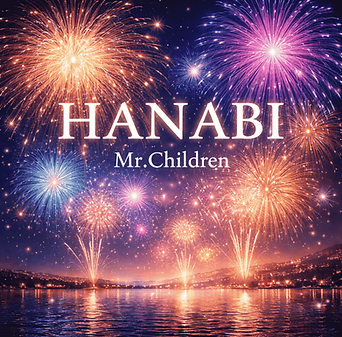
This article offers cultural and emotional commentary on selected lyric excerpts, focusing on meaning, nuance, and context rather than literal translation.
Only short excerpts are quoted for commentary purposes; full lyrics are not provided, and all rights belong to the respective rights holders.
🎆 HANABI by Mr.Children
— Japanese Lyric Cultural & Language Room —
Released on September 3, 2008, Mr.Children’s 33rd single "HANABI" is a phenomenal long-seller in Japanese music history and a definitive anthem of the 2000s. This track served as the theme song for the Fuji TV drama series Code Blue, consistently featured from the first season (2008) through to the feature film (2018). For a single drama series to use the same song for over a decade is an extremely rare case in Japanese television history, proving that this song was the very "soul" of the story.
The lyrics resonate perfectly with the struggles of young doctors standing on the front lines of emergency medicine, caught between the lives they can save and those they cannot. Kazutoshi Sakurai’s lyrics, which seek a "faint light toward the future" amidst "past pain," resonated deeply with the tension and helplessness portrayed in the show. The title "HANABI" (Fireworks) symbolizes the Japanese concept of mujo (impermanence)—the brilliant flash followed by silence—while also depicting a longing for "ideals" that illuminate the night sky at an unreachable height.
Below are seven culturally rich lyric expressions, explained with linguistic nuance for English speakers.
1. 答えようもないその問いかけは 日常に葬られてく
Romaji: Kotaeyō mo nai sono toikake wa / Nichijō ni hōmurareteku
Cultural Nuance: Questions without answers and internal conflicts about what kind of ideals or hopes to hold are buried and lost within the busyness of daily life.
🗣 Japanese Insight: Literal meaning: That inquiry, for which there is no way to answer, is being buried in daily life. Immediately preceding this line, the lyrics pose earnest self-questions: "What kind of ideals should I draw? What kind of hope should I hold as I move forward?" In life, philosophical dilemmas and uncontrollable emotions often fall by the wayside as reality moves on heartlessly. Especially in a high-stakes environment like a medical emergency, one is not even allowed the luxury of stopping to grieve or worry. By using the powerful verb hōmuru (to bury/inter/consign to darkness), which originally refers to a funeral or burial, the song portrays the lonely battle of modern people who must forcibly suppress unsolvable conflicts deep within their hearts just to survive the "daily routine" right in front of them.
2. 君がいたらなんていうかなぁ 「暗い」と茶化して笑うのかなぁ
Romaji: Kimi ga itara nante iu kana / "Kurai" to chakashite warau no kana
Cultural Nuance: If you were here, I wonder if you would tease me for being "too dark" and laugh my overly serious worries away.
🗣 Japanese Insight: Literal meaning: If you were here, what would you say? Would you make fun of me being "dark" and laugh? The verb chakasu means to turn a serious conversation into a joke or to tease someone to lighten the mood. This is not a mean-spirited mockery; rather, it is a form of intimate communication intended to ease the other person’s tension. The lyrics depict an earnest reliance on and trust in another person—a wish for the "you" who is bright and cheerful to rescue the narrator from a loop of melancholic thoughts by "making fun" of them. It carries a distinctly Japanese sense of setsunasa (heart-rending sorrow) as the narrator chases the phantom of a "you" who may be lost or far away.
3. 決して捕まえることの出来ない 花火のような光だとしたって
Romaji: Kesshite tsukamaeru koto no dekinai / Hanabi no yō na hikari da to shitatte
Cultural Nuance: Even if it is a distant, dazzling light of an ideal, like fireworks blooming high in the night sky that can never be caught.
🗣 Japanese Insight: Literal meaning: Even if it were a light like fireworks that can never be caught. Here, the central metaphor of "fireworks" appears. In Japan, fireworks are a grand symbol of beauty that illuminates the high, unreachable sky like massive flowers, moving people to tears with their brilliance. However, that radiance is momentary and can never be physically grasped. In this context, fireworks are not merely a symbol of "transience"; they serve as a metaphor for "hopes" and "ideals" that are incredibly beautiful yet sit at a height where they are just out of reach. By following this with da to shitatte (even if that were the case), the song expresses the resilience of the human will—the determination to keep reaching for that light even while knowing it cannot be caught.
4. 臆病風に吹かれて 波風がたった世界を どれだけ愛することができるだろう?
Romaji: Okubyōkaze ni fukarete / Namikaze ga tatta sekai o / Dore dake aisuru koto ga dekiru darō
Cultural Nuance: In a world where we are blown by the wind of cowardice and where trouble and friction never cease, how much will I be able to love this imperfect world?
🗣 Japanese Insight: Literal meaning: Blown by the wind of cowardice, how much can I love this world where "waves and wind" have risen? Okubyōkaze (the wind of cowardice) is an idiomatic expression comparing the wavering of a fearful heart to a gust of wind. Similarly, namikaze ga tatsu (waves and wind rising) means that trouble or friction has occurred in a once-peaceful place. This lyric confronts the reality that the world is never ideal and one's own heart is never perfectly strong. It poses a question of resolve: once faced with an "imperfect self" and a "difficult world," can we still choose to love? This theme deeply overlaps with the doctors in Code Blue who must continuously ask themselves this question while facing harsh realities.
5. 考えすぎで言葉に詰まる 自分の不器用さが嫌い
Romaji: Kangaesugi de kotoba ni tsumaru / Jibun no bukiyō sa ga kirai
Cultural Nuance: I hate my own awkwardness and clumsiness—thinking too deeply until I am at a loss for words.
🗣 Japanese Insight: Literal meaning: I hate my own clumsiness/awkwardness for overthinking and becoming choked up with words. The word bukiyō (clumsiness/awkwardness) refers not just to a lack of manual dexterity, but to a way of living—being poor at expressing emotions or unable to navigate society cleverly. The narrator hates themselves for losing their words because they are trying to think too sincerely. The lyrics that follow—expressing an even deeper hatred for a self that acts "strangely cleverly" just to fit in—sharply point out the self-loathing felt by modern individuals caught in a dilemma of self-consciousness. It depicts the pain that arises precisely because one yearns to be authentic.
6. 未来が僕らを呼んでる その声は今 君にも聞こえていますか?
Romaji: Mirai ga bokura o yonderu / Sono koe wa ima kimi ni mo kikoete imasu ka
Cultural Nuance: The future is calling out to us. I wonder if that voice of hope is reaching you now as well.
🗣 Japanese Insight: Literal meaning: The future is calling us. Can you hear that voice now, too? In this phrase, the "future" is personified, proactively calling out to the characters. For those trapped by past regrets or current suffering, this represents a shift in perspective: the future is not something far away, but something speaking to us from the other side. The inquiry of wanting to share this not alone, but with a "you," provides a sense of open light to an otherwise lonely ballad. It is a hopeful phrase that foreshadows the bond of the drama's characters as they deepen their trust over ten years and move toward the future together.
7. さよならが迎えに来ることを 最初からわかっていたとしたって
Romaji: Sayonara ga mukae ni kuru koto o / Saisho kara wakatte ita to shitatte
Cultural Nuance: Even if I knew from the very beginning that the day of "goodbye" would eventually come to collect us.
🗣 Japanese Insight: Literal meaning: Even if I knew from the start that "goodbye" would come to pick me up. Personifying Sayonara (Goodbye) as something that "comes to pick you up" suggests a resolve to accept the end as an unavoidable fate. All life has an end, and every relationship must eventually face a parting. By staring directly at this absolute truth of "separation," and yet still crying out "One more time" (mō ikkai)—wishing to meet or reach out again—the song achieves a supreme affirmation of life. This is the reason the song continues to shake the souls of listeners; it is a supreme confession of love based on the premise of despair.
🎤 Emotional Summary
"HANABI" is a song about the "indomitable wish" of humans who continue to reach out, again and again, for a light that may disappear in an instant. Throughout the ten years it spent alongside the drama Code Blue, this song pushed the backs of those fighting in the harshest environments where life and death are decided, while simultaneously staying close to the hearts of those of us sinking into the worries of daily life.
Even when blown by the "wind of cowardice" and despairing at our own "awkwardness," we cannot help but pray for "one more time." That unrefined yet beautiful affirmation of life is packed into the refrain of the chorus. The song makes us feel that it is in the darkness after the fireworks fade that the world we truly ought to love expands. It is a crowning jewel of J-POP.
🔍 Related Articles
🎆 打上花火 Uchiage Hanabi by DAOKO × Kenshi Yonezu
🌊 水平線 Suipeisen by back number
📝 Q&A for "HANABI" by Mr.Children
🎆 Q1. Why are "Fireworks" (Hanabi) the central metaphor for a medical drama?
A: In Code Blue, doctors face the "Flash of Life." A life is saved in a brilliant moment of skill, or it vanishes in an instant. Like "Hanabi" (花火), human life is breathtakingly beautiful but technically "Impermanent" (Mujō). As your insight noted, fireworks are "Lights that can never be caught" (Tsukamaeru koto no dekinai). For the characters, "Hanabi" represents the ideal version of themselves—the perfect doctor who saves everyone—which remains just out of reach in the high sky, leaving them to work in the darkness of reality.
🌬️ Q2. What is the cultural weight of "Okubyōkaze" (The wind of cowardice)?
A: This is a very "Sakurai-esque" (Kazutoshi Sakurai's style) expression. Instead of saying "I am scared," he says he is "Blown by the wind of cowardice" (臆病風に吹かれて). This implies that fear is an external, natural force that hits everyone. In the medical field, one mistake can be fatal, making "cowardice" a constant companion. By acknowledging this "wind," the song validates the listener's anxiety. It suggests that the goal isn't to stop the wind, but to learn how to "Love the world" (Sekai o aisuru) even while shivering from its chill.
🤝 Q3. How does "Sayonara ga mukae ni kuru" (Goodbye comes to pick me up) change the meaning of parting?
A: Normally, "Goodbye" is an end. But by personifying it as someone who "Comes to pick you up" (迎えに来る - Mukae ni kuru), the song treats death or separation as a "Fated Visitor." It’s a stoic, Japanese perspective: we are all living on borrowed time. Because the "End" is guaranteed from the start (Saisho kara wakatte ita), the desperate plea of "Mō ikkai" (もう一回 - One more time) becomes more sacred. It transforms the act of living from a passive wait for the end into an active, defiant protest of love.
📘 Notes on Cultural & Emotional Context
This section explores selected phrases from the song to highlight their emotional nuance and cultural background within Japanese music and storytelling.
Rather than presenting a word-for-word translation, the focus is on how these expressions convey feeling, atmosphere, and narrative meaning.
The insights are intended for readers interested in Japanese songs, anime, and culture, offering interpretive context rather than formal language instruction.
📜 Disclaimer
This article provides cultural and emotional commentary on selected lyric excerpts for informational purposes.
Only short excerpts are quoted for commentary; full lyrics are not provided.
All rights belong to the respective rights holders, and no ownership is claimed.
Advertisements or affiliate links may appear to support the site.
If you enjoyed this article, feel free to leave a comment below👇
You’re also welcome to share your thoughts or request songs you’d like us to explore in the future😊