


This article offers cultural and emotional commentary on selected lyric excerpts, focusing on meaning, nuance, and context rather than literal translation.
Only short excerpts are quoted for commentary purposes; full lyrics are not provided, and all rights belong to the respective rights holders.
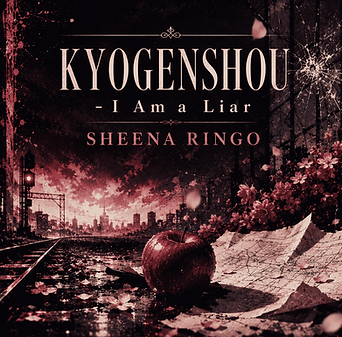
🍎 虚言症 Kyogenshou - I Am a Liar by Sheena Ringo
— Japanese Lyric Cultural & Language Room —
Serving as the opening track of Sheena Ringo's second album, Shouso Strip, released on March 31, 2000, "Kyogenshou" holds a special meaning in her career. This masterpiece is featured here in response to an enthusiastic request from a JLR YouTube listener who commented, "Out of all Sheena Ringo's songs, I love this one the most."
While early Sheena Ringo is often associated with impulsive, fierce rock sounds, this track is cherished deeply among core fans as a hidden masterpiece. Listeners frequently comment on YouTube, "This is the song where you can truly feel her earliest roots," and "Everyone secretly treasures this piece."
When watching her live concert footage, she addresses the audience during the intro of this song, saying, “Please listen to the first song I ever wrote.” As she noted in her official commentary, “This was written even earlier than the oldest song I had released until now.” This track can truly be called a monumental piece that marks the very beginning of her songwriting.
This song is also deeply connected to a real-life event that struck her with an immense shock. When she was a 15-year-old high school freshman, she read a small newspaper article about a girl of the same age who committed suicide by lying on the train tracks. In her self-liner notes, Sheena Ringo explicitly stated that "kimi" (you) in the line "for your sake" refers to that deceased girl. Looking back years later, she self-deprecatingly remarked, "I guess I was incredibly arrogant back in high school," for declaring, "I can sing for your sake too." Nevertheless, this incident became a major starting point for her creation.
In a 2017 Yahoo! News feature interview, Sheena Ringo revealed that she was born with a severe illness called congenital esophageal atresia. She experienced a two-day emergency surgery shortly after birth. Because of this, she has always kept a strong awareness of herself as "someone whose life was saved."
Reflecting on that article about the 15-year-old girl, she stated, "I still feel a catch in my heart and a sense of guilt." She added, "As long as I continue to live, I want to keep thinking about the feelings of girls who want to disappear, in the present continuous tense. Clearly, that was the catalyst that made me decide to dive into the world of J-POP." Furthermore, she expressed, "I want to flood the world with materials that take the side of girls. I wish the world would become a place where all 15-year-old girls can cheerfully say, 'Life is easy! A piece of cake!'" Her strong desire to keep thinking about girls pushed to the brink and to always be on their side stands as the unchanging foundation of her creative work.
The story surrounding the title of this song is also highly cynical and fascinating. In the early demo stage of production, it was given the tentative title "Daijoubu" (It's Okay), which is the core message of the lyrics. However, it was renamed to "Kyogenshou" (Munchausen syndrome / Compulsive Lying) upon release. She remarked, "Looking back now, does it mean that what I firmly believed at that time turned into a lie?" To straight-up declare "It's okay" to a girl pushed to the brink of wanting to die might actually turn into an irresponsible "lie" (kyogen). Her unique, sincere self-doubt toward her own words was likely sublimated into this very title.
You can also enjoy this song as a YouTube slideshow. Feel free to check it out.
▶︎Sheena Ringo 椎名林檎 - Kyogenshou 虚言症 (I Am a Liar) Lyrics Meaning
In this article, we explore seven key phrases from the Japanese lyrics, including their romaji pronunciation and deeper cultural meaning. Below are seven culturally rich lyric expressions, explained with linguistic nuance for English speakers. Interpretations may vary depending on the person.
1. しかし何故にこんなとも 眼が乾く気がするのかしらね
Romaji: Shikashi naze ni konnanimo mega kawaku ki ga suru no kashira ne
Cultural Nuance: "Why does it feel like my eyes are so dry?"
🗣️ English Insight: "Mega kawaku" (eyes feeling dry) does not simply refer to a physical condition. It depicts a mental landscape where someone has cried too much to shed more tears due to intense shock. The heart reacts oversensitively and gets hurt even by minor stimuli like rain or crowds, which should be mere natural phenomena or background noise. This phrase quietly expresses an overwhelming sensitivity and fragility, as if one's mental barriers are completely broken and everything in the world feels like an attack.
2. 黄色の手一杯に広げられた地図には 何も無いのだ
Romaji: Kiiro no teippai ni hirogerareta chizu niwa nani mo nai noda
Cultural Nuance: "Even if I spread out the map of my future as wide as my hands can reach, I can find no answers or destinations anywhere."
🗣️ English Insight: Psychologically, the color "yellow" represents "caution," "anxiety," or a "warning." In this context, "Kiiro no te" (yellow hands) implies the protagonist's nervous restlessness or a somewhat sickly psychological state. The protagonist spreads out a "map" toward the future as wide as her hands can reach, but finds absolutely nothing there. This vivid color metaphor brilliantly captures a profound sense of emptiness unique to youth, portraying a sudden loss of vision where the immediate future turns completely dark.
3. 魚の目をしているクラスメイトが敵では 決して無い
Romaji: Sakana no me o shiteiru kurasumeito ga teki dewa kesshite nai
Cultural Nuance: "Please do not just view your classmates, who look at you with lifeless, cold eyes, as your enemies."
🗣️ English Insight: In Japanese, the metaphor "dead fish eyes" describes cloudy eyes devoid of emotion. While one cannot rule out that the girl faced actual isolation or bullying at school, the phrasing "sakana no me o shiteiru" offers a detached perspective: it suggests that these classmates might also be completely exhausted by life, numbing their own hearts. Amidst despair where everything feels hostile, this line gently sheds light on the reality that the surrounding people are also fragile souls carrying their own fatigue.
4. 線路上に寝転んでみたりしないで大丈夫
Romaji: Senrojou ni nekorondemitari shinaide daijoubu
Cultural Nuance: "You don't need to resort to extreme actions like ending your life."
🗣️ English Insight: Japanese Insight (English): This line is directly connected to the small newspaper article Sheena Ringo read when she was a first‑year high school student—about a girl her own age who lay down on the train tracks and ended her life. Ringo has stated that the “you” in “kimi no tame ni” refers to that girl, making this phrase a quiet message addressed to her. Instead of saying “Don’t lie down” or “Don’t die,” she chooses the gentler, more distant wording “don’t go lying down on the tracks”, a phrasing that avoids provoking a fragile, overwhelmed heart. It carries a soft, side‑by‑side kind of compassion— a quiet plea that says, “I know the despair that brought you there. But please, don’t go any further.”
5. 徒に疑ってみたりしないで大丈夫
Romaji: Itazura ni utagattemitari shinaide daijoubu
Cultural Nuance: "You don't need to close off your heart or become overly paranoid by fearing the malice of the world and others."
🗣️ English Insight: "Itazura ni" is a slightly old-fashioned, literary word meaning "pointlessly" or "without any good reason." Ringo speaks to a girl to whom the entire world looks like an enemy. She whispers, "You don't need to fear and doubt your surroundings so much," softly thawing a frozen heart. It radiates a deep affection toward a young soul that has raised its thorns out of a defensive instinct to avoid further pain.
6. 君は常に常にギリギリで生きる
Romaji: Kimi wa tsune ni tsune ni girigiri de ikiru
Cultural Nuance: "You are always living on the absolute edge of your mental limits—holding on in a dangerous state where one wrong step could cause you to collapse."
🗣️ English Insight: The word "Girigiri" is an onomatopoeic expression denoting an extreme state with no room to spare. Ringo vividly captures the precarious reality of a girl for whom merely existing is painful. Notably, this mirrors "boroboro" (battered/worn out)—another onomatopoeia used earlier in the verses. While the narrator, "Atashi," lives her life constantly shattered and boroboro, she continuously thinks of "Kimi," who is enduring on the edge, girigiri. The contrast between these two painful onomatopoeias highlights a prayer-like connection of shared wounds.
7. 眩しい日に身を委せることこそ悪いこととは云わない
Romaji: Mabushii hi ni mi o makaseru koto koso warui koto to wa iwanai
Cultural Nuance: "Stepping out of the darkness to accept a bright, warm everyday life is by no means a sinful thing."
🗣️ English Insight: People accustomed to being hurt sometimes experience a strange sense of guilt about becoming happy or stepping into a bright environment. Ringo focuses on "Mabushii hi" (a dazzling day) and gently validates "Mi o makaseru" (surrendering oneself) to that world of light. She tells the listener that accepting happiness naturally is not a bad thing. Like accepting a pleasant wind playing with one's hair, this beautiful line carries a desire to support the listeners, softly coaxing them to forgive themselves.
Emotional Summary
Sheena Ringo’s "Kyogenshou" is a remarkable song born from the tragic story of a young girl's death. Even now, nearly 25 years later, it continues to give many listeners a deep sense of empathy.
Ringo generally avoids writing straightforward cheering songs, yet she penned this exposed warmth during her early days under the title "Daijoubu." Changing it to the cynical title "Kyogenshou" reveals her deep understanding of the weight of words, harboring her earnest desire: "My words might just become a lie, but I still want to be there for you." She lives her own life completely "boroboro" (battered), yet constantly thinks of an unknown someone living on the absolute "girigiri" (edge). Her overwhelming affection acts like laying a gentle cushion of song over the train tracks, continuing to offer quiet comfort to listeners for generations to come.
🔍 Related Articles
🎸 丸の内サディスティック Marunouchi Sadistic by Sheena Ringo
👑 歌舞伎町の女王 Kabukichō no Joō by Ringo Sheena
📝 Q&A for "Kyogenshou" by Sheena Ringo
🚂 Q1. What is the real-life tragic backstory behind Sheena Ringo's song "Kyogenshou" (I Am a Liar)?
A: The song was deeply inspired by a shocking newspaper article that 15-year-old Sheena Ringo read during high school. It reported the suicide of a girl her own age who lay down on train tracks. The "Kimi" (you) in the lyrics directly refers to this deceased girl. This tragic event became a defining catalyst for Ringo, triggering her ultimate decision to enter the professional J-POP industry and create music that "sides with young girls."
🩹 Q2. Why did Sheena Ringo change the song's title from "Daijoubu" (It's Okay) to "Kyogenshou" (I Am a Liar)?
A: During the early demo stage, the track was tentatively titled "Daijoubu" to offer reassurance to the girl on the tracks. However, Ringo later altered it to "Kyogenshou" out of a cynical yet deeply honest self-doubt. She felt that blindly telling someone pushed to the absolute brink of despair that "everything is okay" might actually be an irresponsible falsehood or a "lie," sublimating her complex guilt into the final title.
🍂 Q3. What do the Japanese terms "boroboro" and "girigiri" mean in the context of the lyrics?
A: Both are crucial Japanese onomatopoeic expressions used to establish raw empathy. "Boroboro" describes a physical or mental state that is heavily battered, torn, and on the verge of collapsing, which Ringo uses to confess that she herself is imperfect and broken. "Girigiri" denotes an extreme, precarious state with absolutely no room to spare. By singing that she lives "boroboro" while the girl lives "girigiri," Ringo builds a down-to-earth connection, refusing to cheer from a safe distance.
📘 Notes on Cultural & Emotional Context
This section explores selected phrases from the song to highlight their emotional nuance and cultural background within Japanese music and storytelling.
Rather than presenting a word-for-word translation, the focus is on how these expressions convey feeling, atmosphere, and narrative meaning.
The insights are intended for readers interested in Japanese songs, anime, and culture, offering interpretive context rather than formal language instruction.
📜 Disclaimer
This article provides cultural and emotional commentary on selected lyric excerpts for informational purposes.
Only short excerpts are quoted for commentary; full lyrics are not provided.
All rights belong to the respective rights holders, and no ownership is claimed.
Advertisements or affiliate links may appear to support the site.
If you enjoyed this article, feel free to leave a comment below👇
You’re also welcome to share your thoughts or request songs you’d like us to explore in the future😊