


This article offers cultural and emotional commentary on selected lyric excerpts, focusing on meaning, nuance, and context rather than literal translation.
Only short excerpts are quoted for commentary purposes; full lyrics are not provided, and all rights belong to the respective rights holders.
⚔️ crossing field by LiSA
— Japanese Lyric Cultural & Language Room —
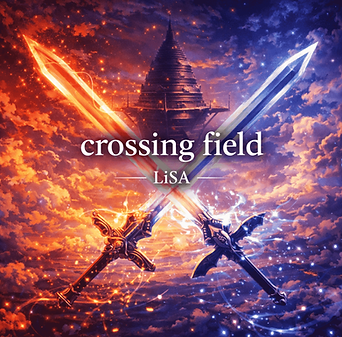
Released on August 8, 2012, "crossing field" is a monumental 3rd single that symbolizes LiSA's rapid ascent following her solo debut. Serving as the opening theme for the "Aincrad Arc" of the TV anime "Sword Art Online" (SAO), it has etched its name into the history of anime music as a legendary masterpiece.
The story takes place within the world's first full-dive VRMMORPG, "Sword Art Online," played via a next-generation VR device called the "NerveGear." However, the glamorous launch of the game is abruptly transformed into a nightmare when the developer, Akihiko Kayaba, declares a terrifying "Death Game." He announces that "Death in the game means death in the real world," and "The only way to clear the game is to defeat the boss on the 100th floor, the top of the floating castle Aincrad." Amidst the despair of 10,000 trapped players, the protagonist Kirito fights as a lonely solo player, while the heroine Asuna serves as the sub-leader of the Knights of the Blood Oath, both risking their lives to complete the game.
The title "crossing field" literally refers to a "place where paths cross." In a virtual world where death is always a step away, it signifies the place where lonely pasts and hearts trembling with cowardice intersect, transforming into an unbreakable bond of trust. LiSA's energetic and edgy vocals perfectly embody both the sharpness of Kirito’s swordplay and the depth of Asuna’s hidden compassion. Even more than a decade after its release, it continues to be sung as a universal language wherever SAO fans gather around the world.
In this article, we explore seven key phrases from the Japanese lyrics, including their romaji pronunciation and deeper cultural meaning. Below are seven culturally rich lyric expressions, explained with linguistic nuance for English speakers.
1. 認めていた臆病な過去
Romaji: Mitomete ita okubyō na kako
Cultural Nuance: "The past when I had accepted and given up on my own cowardice—the days when I was alone and trembling."
🗣 Japanese Insight: The verb "Mitomeru" (認める) here means more than just "to admit" or "to acknowledge." It refers to the state of facing one's own weakness head-on and accepting it as a part of oneself. Immediately after being trapped in the death game, everyone felt the primal fear of not wanting to die. The reason Kirito avoided others and remained a solo player was rooted in his "cowardice" regarding the potential loss of someone close to him. By "admitting" this weakness rather than hiding it, he finds the strength to pick up his weapon for the sake of others. This opening line depicts the quiet resolve of a player transforming into a "warrior" in an inescapable virtual world.
2. 儚い心 乱して
Romaji: Hakanai kokoro midashite
Cultural Nuance: "Violently stir up my fragile, fleeting heart that feels as though it might vanish at any moment."
🗣 Japanese Insight: "Hakanai" (儚い) is a uniquely Japanese word used to describe something beautiful precisely because it is unstable and likely to disappear, like morning dew or a dream. In the world of Aincrad, everything is merely programmed data; if a player dies, their existence is instantly deleted. In such an uncertain world, the "hearts" of Kirito and Asuna are also "Hakanai"—fragile things that could break at any time. This phrase expresses how the presence of another person "stirs up" (midashite) their quiet resignation, violently setting their stagnant destinies into motion through their encounter.
3. どんな不安纏っても振り払っていく
Romaji: Donna fuan matotte mo furiharatte iku
Cultural Nuance: "No matter how heavy the anxiety I may wear (clothe myself in), I will powerfully shake it off and move forward."
🗣 Japanese Insight: "Matou" (纏う) refers to a state where something is closely attached to the body and cannot be easily removed, much like wearing clothes or a scent. The pressure carried by the front-line players and the constant anxiety of not knowing if they will survive tomorrow cling to them like heavy armor. However, by connecting this to the powerful action of "Furiharau" (振り払う - to shake off/flick away), the lyric symbolizes a strong life force—the will to not be swallowed by fear, but to repel it of one's own volition and swing one's sword toward the top floor.
4. 触れればすべて思い出して
Romaji: Furereba subete omoidashite
Cultural Nuance: "If I can just touch that light (you), I can remember everything—the precious emotions I had forgotten and the reasons to survive."
🗣 Japanese Insight: "Fureru" (触れる - to touch) is one of the most critical senses in a full-dive VR environment. Even in a world made of data, "touching" the warmth of someone's hand allows the players to reaffirm that they are not just avatars, but flesh-and-blood humans. It depicts how memories of the real world that were beginning to go numb, the joy of loving someone, and the vow to "always return alive" all come rushing back to the heart through the tactile sensation at the fingertips. It sounds like a ritual of "re-verification" to break through despair.
5. それはいつも 暖かいのに痛くて
Romaji: Sore wa itsumo atatakai noni itakute
Cultural Nuance: "The feelings you give me are always as warm as a sunlit spot, yet they simultaneously bring a painful, heart-wrenching ache."
🗣 Japanese Insight: By connecting the polar opposite sensations of "Atatakai" (暖かい - Warm) and "Itai" (痛い - Painful) with "~noni" (yet/despite), this line expresses a deep conflict. To love someone within a death game is to accept the ultimate fear of potentially losing them. As Kirito’s feelings for Asuna deepen, his heart is saved (warm) but simultaneously aches violently (painful) at the mere thought of failing to protect her. This phrase vividly exposes the weight of "real love" born in a virtual world and the suffering that comes with it.
6. 繋ぐ確かな願い重なり合って
Romaji: Tsunagu tashika na negai kasanariatte
Cultural Nuance: "The certain wishes we held onto have overlapped and resonated together as one."
🗣 Japanese Insight: "Kasanariatte" (重なり合って - Overlapping) is an expression that perfectly symbolizes the "crossing" in the title. Asuna's wish to clear the game and Kirito's wish to protect the person he loves intersect on the fields of Aincrad. When their destinies, which had been following separate trajectories, overlap, an "explosive strength" is born that neither could achieve alone. Here lies the ultimate form of "trust," where their souls synchronize completely across the barriers of data, choosing to face their fates together.
7. 二人信じた絆はそう鮮明に
Romaji: Futari shinjita kizuna wa sō senmei ni
Cultural Nuance: "Only the bond we both believed in shines vividly and clearly within this uncertain world."
🗣 Japanese Insight: "Senmei" (鮮明) refers to a state where shapes and colors stand out clearly without a hint of cloudiness. In the world of SAO, where the surrounding scenery and even one's own body are "imitations" made of polygons and code, the "Kizuna" (絆 - Bond) they cultivated together is the only thing that exists with a vividness (senmei) more real than anything in the actual world. This conviction, seized at the end of the death game, becomes the ultimate weapon to break through the false world and carve out a path to the truth.
🎤 Emotional Summary
"crossing field" is a story that traces the trajectory of lonely souls as they "cross" paths in the extreme field of a death game, eventually arriving at true love. LiSA has ingrained into her voice the figures of Kirito and Asuna—who acknowledge their cowardly pasts, regain their humanity through touch, and continue to run despite the pain that comes from their warm love.
That very pain—the fact that it is "warm yet painful"—is the greatest proof that they are "alive" in the virtual world. When their wishes overlap vividly, the skies of Aincrad are filled with the light of hope. When we listen to this song, we gain the courage to take up our swords once more, believing in the "certain bonds" that support us no matter what difficult reality we face.
📝 Q&A for "crossing field" by LiSA
⚔️ Q1. What is the symbolic meaning of the title "crossing field" in the context of Sword Art Online?
A: The title "crossing field" refers to the "place where paths intersect." In the deadly virtual world of Aincrad, it symbolizes the moment where isolated hearts—specifically the "solo player" Kirito and the driven leader Asuna—overlap. Their personal traumas and "cowardly" pasts (okubyō na kako) cross to transform into a unified force of "Trust." It represents the intersection of two souls whose combined will becomes the ultimate weapon to clear the game and return to reality.
🌡️ Q2. Why do the lyrics describe love in a virtual world as "warm yet painful" (atatakai noni itakute)?
A: This phrase captures the high stakes of a "death game" where dying in-game means death in the real world. To love someone in SAO is to find comfort and "warmth" (atatakai), but it simultaneously brings a sharp, stinging "pain" (itakute)—the constant, agonizing fear of losing that person forever. LiSA’s vocals convey this emotional weight, highlighting that in a world made of digital code, the vulnerability of human connection is the only thing that feels truly "real."
✨ Q3. How does the Japanese concept of "Hakanai" explain the atmosphere of the song?
A: The lyric "Hakanai kokoro midashite" uses the aesthetic term Hakanai (儚い), which describes something beautiful yet fleeting and transient, like a dream or cherry blossoms. In Sword Art Online, since players can be "deleted" instantly upon death, their very existence is hakanai. The song suggests that instead of fearing this transience, the characters allow their hearts to be "disturbed" (midashite) by their meeting, using that friction to spark the resolve needed to survive and shatter the false reality.
📘 Notes on Cultural & Emotional Context
This section explores selected phrases from the song to highlight their emotional nuance and cultural background within Japanese music and storytelling.
Rather than presenting a word-for-word translation, the focus is on how these expressions convey feeling, atmosphere, and narrative meaning.
The insights are intended for readers interested in Japanese songs, anime, and culture, offering interpretive context rather than formal language instruction.
📜 Disclaimer
This article provides cultural and emotional commentary on selected lyric excerpts for informational purposes.
Only short excerpts are quoted for commentary; full lyrics are not provided.
All rights belong to the respective rights holders, and no ownership is claimed.
Advertisements or affiliate links may appear to support the site.
If you enjoyed this article, feel free to leave a comment below👇
You’re also welcome to share your thoughts or request songs you’d like us to explore in the future😊