


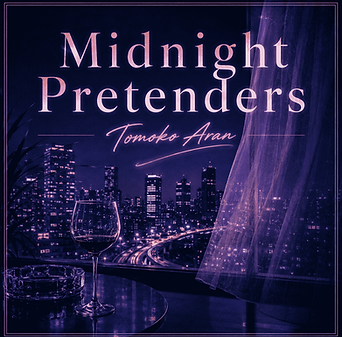
This article offers cultural and emotional commentary on selected lyric excerpts, focusing on meaning, nuance, and context rather than literal translation.
Only short excerpts are quoted for commentary purposes; full lyrics are not provided, and all rights belong to the respective rights holders.
🍷 Midnight Pretenders by Tomoko Aran
— Japanese Lyric Cultural & Language Room
“Midnight Pretenders,” included on Tomoko Aran’s album Fuyū Kūkan (Floating Space) released on May 28, 1983, did not achieve major commercial success at the time. However, amid the recent global city-pop revival, the song has undergone a remarkable re-evaluation, gaining enough popularity to be reissued as a 7-inch single in 2021. Its cultural impact became definitive in 2022, when global artist The Weeknd officially sampled the track in “Out of Time” on his album Dawn FM.
During the album’s production, the use of a “supercomputer-generated jacket design”—a highly cutting-edge concept for the era—also drew attention. Its futuristic visual aesthetic perfectly complements the album’s distinctive sense of floating weightlessness.
Within the broader city-pop landscape, this song occupies a unique position as a slow-ballad-leaning disco kayō. Composer Tetsurō Oda has spoken about being influenced by the falsetto slow ballads played during “cheek time” at discos he frequented as a teenager. This influence is reflected in the song’s mellow, floating melodic lines.
Masatoshi Nishimura’s synth-driven urban electro sound blends seamlessly with Aran’s lyrical world of “adult nighttime escapism,” creating a sophisticated and atmospheric sonic universe.
Throughout the lyrics, we find not only the glamour of the city at night but also the loneliness that lurks within it, along with the bittersweetness of fleeting relationships built without promises.
In this article, we explore seven key phrases from the Japanese lyrics, including their romaji pronunciation and deeper cultural meaning. Below are seven culturally rich lyric expressions, explained with linguistic nuance for English speakers. Interpretations may vary.
1. 背中のホクロを なぞれば にじむ 涙
Romaji: Senaka no hokuro o nazoreba nijimu namida
Cultural Nuance: “As I gently trace the small mole on your back with my fingertip, a quiet ache wells up from deep inside me, and my vision softly blurs with tears.”
🗣 Japanese Insight:
A distinctive mole can sometimes function in literature and visual storytelling as a symbol of individuality or hidden intimacy. The expression nijimu namida (“tears that blur/bleed”) conveys not an explosive outburst of emotion but a quiet, restrained sorrow—an aesthetic deeply rooted in Japanese emotional subtlety. Without stating it outright, the line communicates the profound closeness between the two.
2. 泳ぎ疲れた 魚のように 眠りを 貪る人
Romaji: Oyogitsukareta sakana no yō ni nemuri o musaboru hito
Cultural Nuance: “A lover who sleeps deeply, as if they were a fish exhausted from swimming.”
🗣 Japanese Insight:
The metaphor of a “fish tired from swimming” evokes someone who continues moving even while asleep—yet here, the fish is exhausted. This suggests the lover carries hidden fatigue and loneliness from navigating the pressures of urban life. The verb musaboru (“to devour, to indulge in”) intensifies the sense that sleep is not mere rest but an escape to fill an emotional void. It highlights the protagonist’s tender and caring gaze.
3. 行く先 告げない 旅人
Romaji: Yukusaki tsugenai tabibito
Cultural Nuance: “A person who never reveals where they are headed next—capricious like the wind, and unwilling to show me their true heart.”
🗣 Japanese Insight:
This short phrase encapsulates the uncertainty of their relationship. The man’s secrecy is expressed through the archetype of the tabibito (“traveler”), a figure often depicted in Japanese culture as someone who never settles, always searching for a place to belong.
The negative form tsugenai (“does not tell”) implies not only withholding information but also refusing to make future promises. By calling him a “traveler” rather than a “lover,” the protagonist accepts—almost coldly—that she is merely a temporary stop in his journey.
4. 闇に 隠れて 束の間 ぬくもり分け合う
Romaji: Yami ni kakurete tsukanoma nukumori wakeau
Cultural Nuance: “Hiding in the darkness of night, sharing each other’s warmth for only a brief moment, away from the eyes of the world.”
🗣 Japanese Insight:
This line most vividly reveals that their relationship is a secret affair. “Hiding in the darkness” evokes both the illicit comfort of nighttime and the painful reality that their bond cannot exist in the light.
The phrase tsukanoma (“a brief moment”) emphasizes the fleeting nature of their intimacy. And wakeau (“to share”) suggests two equal, lonely souls dividing a scarce resource—warmth—between them.
5. 窓に しのび込む 朝が 急き立てる 別れ
Romaji: Mado ni shinobikomu asa ga sekitateru wakare
Cultural Nuance: “The morning light slips silently through the cracks of the closed window, mercilessly urging our parting.”
🗣 Japanese Insight:
By personifying “morning,” the lyrics dramatize the cruel transition from night to day. The verb shinobikomu (“to sneak in”) casts the morning light as an intruder breaking into their secret space.
What the morning “hurries” is not merely physical departure—it is the emotional boundary between their hidden night and the cold reality awaiting them. A single beam of light becomes the decisive signal that their dreamlike escape is over.
6. 深い 海の底に 言えない 言葉 沈めて
Romaji: Fukai umi no soko ni ienai kotoba shizumete
Cultural Nuance: “I sink the words I can never tell you—my true feelings, my love—into the unreachable depths of a dark, silent sea.”
🗣 Japanese Insight:
The “deep sea” symbolizes the innermost, inaccessible part of the protagonist’s heart. The “unspeakable words” refer to desires that could destroy their fragile relationship—“Be mine alone,” “I want to stay with you forever.”
By choosing to “sink” them, she actively seals away her emotions to preserve their fleeting connection. This restraint reflects the Japanese aesthetic of speaking through silence.
7. 約束 交わさぬ 恋人
Romaji: Yakusoku kawasanu koibito
Cultural Nuance: “Lovers who make no promises—not about when they’ll meet again, nor about any future together—connected only by the present moment.”
🗣 Japanese Insight:
This line defines the fragile essence of their relationship. The classical-sounding negative form kawasanu softens the tone, giving it a resigned, fateful quality.
Though they call each other “lovers,” there is no legal or verbal guarantee beneath it—only freedom paired with unbearable loneliness. In the polished world of city-pop adults, avoiding promises becomes a performance of emotional detachment, even as they are torn inside by the desire to claim each other completely.
🎤 Emotional Summary
Midnight Pretenders transcends the role of mellow urban background music. It sharply captures the duality of loneliness and love experienced by adults living in rapidly modernizing cities.
The mole traced by a fingertip, the lover sleeping like an exhausted fish, the merciless morning light slipping through the window—these cinematic symbols portray two people whose fragile escape can exist only within a dream destined to end.
Their refusal to make promises, and the sinking of true feelings into the “deep sea,” embody a modern form of bittersweet freedom.
In the late-night hours when they shed their social “masks” (Pretenders), the fleeting warmth they share leaves listeners with a powerful nostalgia and tenderness.
Through The Weeknd’s sampling, the song reached global audiences, suggesting that the urban loneliness woven into Showa-era Tokyo continues to resonate across eras and borders.
📚 Sources & References
Tomoko Aran — Fuyū Kūkan (1983) liner notes and release information
Tetsurō Oda — official YouTube commentary on disco ballads and songwriting background
The Weeknd — Dawn FM, “Out of Time” sampling credits and Billboard data
Wikipedia (Tomoko Aran / Floating Space related pages)
🔍 Related Articles
🚪真夜中のドア Mayonaka no Door (Stay With Me) by Miki Matsubara
🌃 プラスティック・ラブ Plastic Love by Mariya Takeuchi
🏙️ Last Summer Whisper by ANRI
📝 Q&A for "Midnight Pretenders" by Tomoko Aran
🌌 Q1. What is the meaning behind Tomoko Aran's "Midnight Pretenders" lyrics?
A: At its core, "Midnight Pretenders" explores the themes of adult nighttime escapism, urban loneliness, and the bittersweet nature of a secret, fleeting affair. The lyrics tell the story of two lovers who share a deep, intimate connection in the darkness of the night but choose to make no promises for the future ("yakusoku kawasanu koibito"). Rather than expressing explosive sorrow, the protagonist practicing emotional restraint—a classic Japanese aesthetic—by actively hiding her true feelings and "sinking" her unspeakable words into the depths of a silent sea ("fukai umi no soko ni ienai kotoba shizumete"). It captures the poignant reality of modern individuals wearing social "masks" (pretenders) by day and seeking temporary warmth by night.
🎧 Q2. How did "Midnight Pretenders" become a global City-Pop hit, and who sampled it?
A: Although originally released on May 28, 1983, as part of Tomoko Aran's album Fuyū Kūkan (Floating Space), "Midnight Pretenders" did not achieve major commercial success at the time. Its global resurgence was fueled by the internet-driven city-pop revival, leading to a highly demanded 7-inch vinyl reissue in 2021. Its status as a timeless masterpiece was permanently cemented in 2022 when global R&B superstar The Weeknd officially sampled the track for his hit single "Out of Time" on the Billboard-charting album Dawn FM. This cross-generational bridge proved that the urban melancholy crafted in 1980s Tokyo possesses a universal resonance that transcends both eras and language barriers.
🎸 Q3. What are the musical features and production secrets of the album Fuyū Kūkan?
A: Musically, "Midnight Pretenders" occupies a unique niche within city-pop as a slow-ballad-leaning disco kayō. Brilliant composer Tetsurō Oda drew inspiration from the soulful, falsetto slow ballads played during "cheek time" (slow dancing hours) at the discos he frequented as a teenager, resulting in the song's signature mellow, floating melodic lines. Arranger Masatoshi Nishimura paired this melody with a cutting-edge, synth-driven urban electro sound that perfectly mirrors the album's title, Fuyū Kūkan (Floating Space). Additionally, the album's futuristic visual identity was amplified by a highly innovative marketing concept for 1983: utilizing a "supercomputer-generated jacket design" to match its weightless sonic universe.
📘 Notes on Cultural & Emotional Context
This section explores selected phrases from the song to highlight their emotional nuance and cultural background within Japanese music and storytelling.
Rather than presenting a word-for-word translation, the focus is on how these expressions convey feeling, atmosphere, and narrative meaning.
The insights are intended for readers interested in Japanese songs, anime, and culture, offering interpretive context rather than formal language instruction.
📜 Disclaimer
This article provides cultural and emotional commentary on selected lyric excerpts for informational purposes.
Only short excerpts are quoted for commentary; full lyrics are not provided.
All rights belong to the respective rights holders, and no ownership is claimed.
Advertisements or affiliate links may appear to support the site.
If you enjoyed this article, feel free to leave a comment below👇
You’re also welcome to share your thoughts or request songs you’d like us to explore in the future😊