


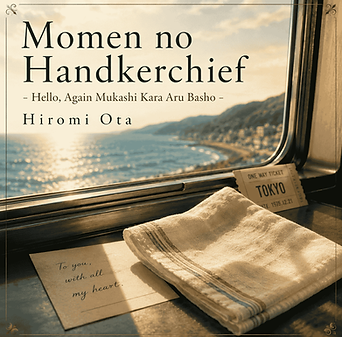
This article offers cultural and emotional commentary on selected lyric excerpts, focusing on meaning, nuance, and context rather than literal translation.
Only short excerpts are quoted for commentary purposes; full lyrics are not provided, and all rights belong to the respective rights holders.
💌 木綿のハンカチーフ - Momen no Handkerchief by Hiromi Ohta
— Japanese Lyric Cultural & Language Room
Released on December 21, 1975, Hiromi Ohta's "Momen no Handkerchief" is an immortal masterpiece that shines brilliantly in the history of Japanese pop music. The track was created by the golden combination of Takashi Matsumoto for the lyrics and Kyohei Tsutsumi for the music. Especially Takashi Matsumoto is a representative Japanese lyricist who has generated numerous hits, including "🧜♀️ 小麦色のマーメイド Komugiiro no Mermaid" and "💍 ルビーの指環 Ruby no Yubiwa" which have also been introduced in our JLR. In recent years, it has been featured as a commercial song for a product of a Japanese beverage manufacturer, and it continues to be loved across generations, being covered by many artists such as The Nolans. Below are seven culturally rich lyric expressions, explained with linguistic nuance for English speakers. Interpretations may vary.
The year 1975 marked a transitional phase in Japan, shifting from the rapid economic growth period (mid-1950s to 1973) into a period of stable growth. During this era, it remained an absolute social phenomenon for young people to move from rural regions to Tokyo either individually or in groups to find employment. This sociological background serves as the realistic foundation for the lyrics of this song, depicting the heartbreaking romance between a boyfriend who gradually conforms to city life and a girlfriend who stays behind in the countryside.
The song features a highly dramatic structure that portrays the interaction between the couple in a dialogue format resembling an "exchange of letters." While the lyrics alone tell a sorrowful story of heartbreak, an anecdote reveals that Tsutsumi judged it better not to make the song dark. He rejected the initial somber, folk-style arrangement and deliberately chose an upbeat, bright melody. This intentional contrast between sad lyrics and a cheerful melody creates a catharsis, transforming the track into a forward-looking story rather than a mere tragedy.
Furthermore, although there are two distinct narrators, one of the song's biggest charms is that Hiromi Ohta performs both roles herself. During recording, Ohta initially worried about how to use different voices, but Matsumoto advised that singing calmly without changing her vocal tone would actually increase the emotional sadness. This established her signature transparent vocal style. Capturing the vast gap between the metropolis and rural areas at the time, this work stands as one of the finest works in Japanese popular music created through "Shisen"—the method of writing lyrics before composing music.
In this article, we explore seven culturally rich phrases from the Japanese lyrics, including their romaji pronunciation, cultural context, and linguistic nuances for English speakers. Interpretations may vary.
1. 恋人よ ぼくは旅立つ 東へと向かう列車で
Romaji: Koibito yo / Boku wa tabidatsu / Higashi e to mukau ressha de
Cultural Nuance: "My love, I am leaving to start a new life, riding on a train bound for Tokyo."
🗣 Japanese Insight: This line opens the dramatic narrative from the male protagonist's perspective. The literal meaning forms a direct announcement of departure. Linguistically, the verb tabidatsu blends "traveling" and "standing up," which inherently signifies a profound life transition or a departure for independence rather than a casual trip. The direction "east" (higashi) functions as a vital cultural metaphor; in Japanese geography, traveling east from rural western or southern districts signifies heading toward Tokyo, the absolute center of modern trends, wealth, and systemic transformation.
In a subsequent interview, Matsumoto shared the origin of this narrative structure. As a creator born and raised entirely in metropolitan Tokyo, his recording director challenged him, noting that a city youth could not truly understand the countryside, meaning the song would fail to resonate with rural listeners. To bridge this gap, Matsumoto modeled the story after the director's own memories of growing up in a Kyushu coal-mining town. He drew directly upon real memories of local train station platforms, where crowds of young people boarded trains for mass employment in the city while their lovers stood watching in tears. This historical reality of post-war domestic migration makes the opening scene incredibly poignant. Translating this requires conveying how a simple compass direction carries the weight of an entire nation's socioeconomic shift, which is often lost in English.
2. はなやいだ街で君への贈りもの 探すつもりだ
Romaji: Hanayada machi de kimi e no okurimono / Sagasu tsumori da
Cultural Nuance: "When I arrive in the bright and bustling city, I plan to look for a gift for you."
🗣 Japanese Insight: This line captures the male protagonist's state of mind as he anticipates his arrival in the metropolis. The literal core is his plan to search for a present. The linguistic focal point centers on the past-tense adjective hanayada, which means to have become brilliant, lively, and prosperous. It reflects his internal excitement as he imagines the sophisticated urban landscape. Culturally, sending an okurimono (gift) from Tokyo to one's hometown was a common social ritual meant to share the prestige and success of the city with loved ones left behind.
The underlying emotional nuance is devoid of malice at this stage; his intention is genuinely affectionate. However, the linguistic structure utilizes the expression sagasu tsumori da (I intend to look), which introduces a subtle psychological distance. In Japanese communication, stating an intention rather than a definitive promise leaves an unconscious margin of ambiguity. This phrase functions as a delicate narrative foreshadowing of the emotional disconnect that will soon emerge. Translating this effectively into English is difficult because the phrase "bustling city" fails to capture the immense psychological contrast a rural resident felt toward Tokyo in 1975, where the city was viewed almost as an entirely different world filled with overwhelming material temptation.
3. ただ 都会の絵の具に染まらないで帰って
Romaji: Tada / Tokai no enogu ni somaranaide kaette
Cultural Nuance: "Just please come back as you are, without being influenced by the city."
🗣 Japanese Insight: This phrase marks the female protagonist's urgent and heartfelt response to her partner's excitement. The literal meaning is an entreaty for him to return uncolored. The primary linguistic feature is the metaphor of somaru (to be dyed or stained), which originates from traditional textile arts but culturally serves as an extensive metaphor for a person's character, values, or morality being completely overwritten by their environment. She pairs this with enogu (paints), visualizing the city's modern stimuli as aggressive, synthetic colors that threaten to erase his natural, unadorned self.
Culturally, this reflects a traditional Japanese aesthetic that values purity, simplicity, and remaining true to one's origins. The word tada (just/only) at the beginning structurally isolates her request, indicating that she completely dismisses his material offers and has only one singular desire. The grammatical structure ends abruptly with kaette (come back), which softens a command into an intimate, desperate plea. This creates an emotional vulnerability that is deeply challenging to translate into English without sounding overly demanding. The word "dye" sounds industrial in Western contexts, whereas somaru carries an elegant, melancholic nuance of dynamic psychological transformation.
4. あなたのキスほどきらめくはずないもの
Romaji: Anata no kisu hodo kirameku hazu nai mono
Cultural Nuance: "No expensive ring or jewel in the city could ever match the brilliance of your kiss."
🗣 Japanese Insight: This line represents the woman's resolute rejection of the man's material corruption in the second verse, where he boasts about sending her a trendy city ring. The literal meaning denies the existence of anything shinier than his kiss. Linguistically, the phrase ~hazu nai represents a grammatical construction of absolute logical and emotional negation, declaring a possibility completely out of the question. Culturally, she is directly referencing the specific luxury items mentioned in the previous line of the lyrics: "diamonds like stars" and "pearls sleeping in the sea."
Her psychological stance reveals a profound contrast in values. While the man begins to measure affection through urban consumerism and monetary wealth, the woman adheres strictly to an invisible, spiritual economy where a simple, physical manifestation of love carries ultimate value. The poetic verb kirameku (to sparkle or shine) is intentionally stolen back from the description of jewelry and reassigned to a human action. This showcases her emotional purity and resilience. Capturing this in English is remarkably difficult because the conversational ending mono acts as a soft, defensive justification, meaning "because it is so," balancing her unyielding refusal with a tender, feminine vulnerability.
5. 見間違うような スーツ着たぼくの写真を見てくれ
Romaji: Mimachigau yōna / Sūtsu kita boku no shashin o mite kure
Cultural Nuance: "Please look at this photo of me in a sharp suit, looking so different you might not recognize me."
🗣 Japanese Insight: Spoken by the man in the third verse, this line illustrates his rapid assimilation into urban society. The literal meaning invites her to look at his photograph. The core linguistic feature is mimachigau, a compound verb meaning to look and mistake one thing for another due to a drastic change in appearance. He combines this with sūtsu (suit), which in 1970s Japan functioned as the ultimate symbol of a white-collar professional, signifying modern Westernization and detachment from rural agricultural life.
The psychological irony here is immense. The man proudly displays his new attire, fully believing it will impress and delight his partner. However, he is completely blind to the fact that he is showcasing the exact transformation into "city paint" that she begged him to avoid. This narrative disconnect aligns perfectly with Matsumoto's artistic interpretation that the man might not even be reading or receiving her letters anymore. The grammatical imperative mite kure represents a casual, masculine demand for validation. This stands in sharp contrast to her previous gentle language, emphasizing their growing emotional divide. It is hard to translate because a Western "suit" carries corporate connotations, whereas in this context, it symbolizes an entire cultural abandonment of rural innocence.
6. 君を忘れて変わってく ぼくを許して
Romaji: Kimi o wasurete kawatteku / Boku o yurushite
Cultural Nuance: "Please forgive me for forgetting you and changing."
🗣 Japanese Insight: This line functions as the man's final, devastating confession in the fourth verse. The literal meaning asks for forgiveness for his transformation. The linguistic engine is the aspect marker ~teku, indicating a continuous, irreversible progression away from a starting point. This grammatical choice shows that his change was not a single sudden betrayal, but a slow, daily erosion of his old identity driven by metropolitan life. Immediately following this line, the lyrics conclude with boku wa kaerenai (I cannot return), establishing his total defeat by the city's gravity.
Culturally, Matsumoto designed this phrase not to vilify the young man, but to paint him as a realistic victim of environmental pressure. In his interviews, Matsumoto noted that when a youth was dropped from a quiet countryside into an urban center overflowing with endless entertainment and modern systems, changing was entirely unavoidable. The plea yurushite (forgive me) shows a tragic self-awareness; he knows he has broken his promise, yet he chooses the city over his romance. Translating this into English requires conveying that "changing" here implies an absolute loss of the original self, a nuance that simple Western words for transformation often fail to capture.
7. ねえ 涙拭く木綿のハンカチーフください
Romaji: Nē / Namida fuku momen no hankachīfu kudasai
Cultural Nuance: "Please give me a cotton handkerchief to wipe away my tears of sadness."
🗣 Japanese Insight: This closing line serves as the ultimate emotional climax where the song's title, Momen no Handkerchief, makes its grand appearance. The literal meaning requests a cotton handkerchief for tears. Linguistically, this phrase is preceded by her statement, "Darling, let me ask for one last selfish wish, I am asking for a gift," showing that she has completely accepted the permanent end of their relationship. Ota famously revealed that her emotions welled up so intensely during recording that she nearly wept, but she maintained a detached, calm vocal delivery under Matsumoto's strict direction, which ultimately amplified the song's poignant sorrow.
The cultural selection of momen (cotton) carries paramount symbolic weight. In 1975, synthetic, glossy chemical fibers were rapidly gaining popularity across Japan as symbols of modern convenience. Cotton, by contrast, possesses no artificial gloss, but it is highly absorbent and carries the distinct texture of a traditional, simple material. By rejecting all the luxurious, metropolitan items he offered throughout the song and requesting a humble cotton handkerchief instead, she reclaims her dignity and honors the unadorned days they once shared in their hometown. It transforms this heartbreak into a beautiful departure (start) toward a new future for both individuals. Translating this requires expressing how a simple fabric choice conveys a profound philosophical rejection of urban materialism, which is a uniquely Japanese lyrical achievement.
🎤 Emotional Summary
Hiromi Ohta's "Momen no Handkerchief" stands as a monumental achievement in Japanese popular music, utilizing an epistolary "exchange of letters" structure to explore the clash of urban and rural values alongside the emotional drifting of a couple. The contrast between the man, who gradually conforms to urban materialism with the passage of time, and the woman, who tries to protect invisible love and the simplicity of her hometown, is vividly arranged without any waste.
What should be specially mentioned is the depth of the message contained in the single word "cotton" (momen), symbolizing the texture that absorbs tears and the purity of the countryside. This work depicts the unavoidable reality that environments change people, rather than simply condemning the man as a bad person. By overlapping Kyohei Tsutsumi's light and upbeat melody with Hiromi Ohta's transparent and calm singing voice, it suppresses the feeling of misery. Instead, it lets listeners feel a refreshing melancholy and a departure toward the next step, continuing to strike the hearts of listeners across eras.
📚 Sources & References
Official release information for Momen no Handkerchief (1975)
Interviews with lyricist Matsumoto Takashi discussing the song’s creative background and thematic intent
Interviews and commentary from composer Tsutsumi Kyohei regarding the song’s arrangement and production choices
Recording-related statements from Hiromi Ohta, including vocal direction and performance approach
Historical materials on 1970s Japan, focusing on regional–urban migration and social context
Official records documenting later CM usage and cover versions of the song
🔍 Related Articles
🧜♀️ 小麦色のマーメイド Komugiiro no Mermaid by Seiko Matsuda
💄 ルージュの伝言 Rouge no Dengon by Yumi Arai (Yumi Matsutoya)
📝 Q&A for "Hello, Again 〜昔からある場所〜" by MY LITTLE LOVER
🎸 Q1. What is the story behind the creation and success of MY LITTLE LOVER's "Hello, Again (Mukashi Kara Aru Basho)"?
A: Released on August 21, 1995, as the theme song for the TV drama Owarani Natsu, "Hello, Again" became a massive hit in Japan, selling over 1.84 million copies. Produced by Takeshi Kobayashi, the track was originally based on an intricate demo by guitarist Kenji Fujii. Kobayashi reshaped it around its iconic chorus key change and elevated the lyrics into a universal theme of youth leaving a familiar place. Driven by Fujii’s opening guitar riff, Jun Aoyama’s deep drumming, and vocalist akko’s crystal-clear vocals, it stands as a definitive 1990s J-pop masterpiece, recently covered by Ayaka for Tales of Arise and Kana Hanazawa for Shōmutsu Toshi.
🌧 Q2. What is the deeper meaning behind the lyrics of "Hello, Again" regarding the transition to adulthood?
A: The lyrics use nature as a metaphor for the psychological shift from adolescence to adulthood. For example, the "season" represents a fleeting, irreplaceable chapter of youth that passes in silence, while the "pouring rain" symbolizes a conscious force wrapping up human regret and guilt. Lines like Itamu kokoro ni kigatsukazu (Without noticing my aching heart) reflect the isolation of pushing through adult realities while suppressing one's own innocence or failing to notice a partner's pain. Ultimately, the song uses heartbreak to explore a grander theme of emotional loss and rebirth.
🌱 Q3. What does the subtitle "Tōi mukashi kara aru basho" (A place from the distant past) symbolize in the song?
A: Rather than a physical hometown, "Tōi mukashi kara aru basho" symbolizes the "internal landscape of the heart"—the innocent mind and true identity that people risk losing in daily adult life. The lyrics suggest that by pushing through hardships, individuals will eventually cycle back (meguru) to their roots. This ties into the final line, "The rain had eventually stopped," delivering a cathartic realization that once you reclaim your innocent, authentic self, the dark periods of loneliness naturally clear up, giving you the resilience to move forward.
📘 Notes on Cultural & Emotional Context
This section explores selected phrases from the song to highlight their emotional nuance and cultural background within Japanese music and storytelling.
Rather than presenting a word-for-word translation, the focus is on how these expressions convey feeling, atmosphere, and narrative meaning.
The insights are intended for readers interested in Japanese songs, anime, and culture, offering interpretive context rather than formal language instruction.
📜 Disclaimer
This article provides cultural and emotional commentary on selected lyric excerpts for informational purposes.
Only short excerpts are quoted for commentary; full lyrics are not provided.
All rights belong to the respective rights holders, and no ownership is claimed.
Advertisements or affiliate links may appear to support the site.
If you enjoyed this article, feel free to leave a comment below👇
You’re also welcome to share your thoughts or request songs you’d like us to explore in the future😊