


This article offers cultural and emotional commentary on selected lyric excerpts, focusing on meaning, nuance, and context rather than literal translation.
Only short excerpts are quoted for commentary purposes; full lyrics are not provided, and all rights belong to the respective rights holders.
📢 Shout Baby by Ryokuoushoku Shakai
— Japanese Lyric Cultural & Language Room
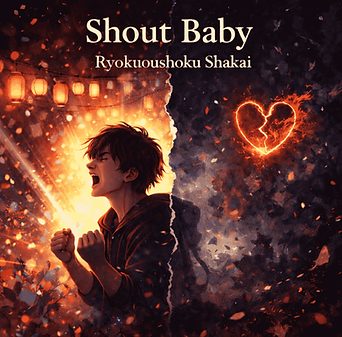
"Shout Baby" by Ryokuoushoku Shakai, released in 2020, was written as the ending theme for the "School Festival Arc" of the fourth season of the TV anime My Hero Academia. This song is a masterpiece of double meanings, flawlessly synchronizing two solitary soul cries: the "Public Story" of the protagonist Deku (Izuku Midoriya) carrying a secret passed down from a legendary hero and the regret of failing to save a life, and the "Hidden Story" of a person drowning in an opaque, unacknowledged relationship, feeling miserable yet unable to let go.
The title "Shout Baby" symbolizes an immature and powerless self (Baby) attempting to release pent-up, sediment-like emotions as a roar (Shout). For those captivated by Japanese culture, we will thoroughly deconstruct the "Light and Shadow" of this song through seven key phrases.
1. いつから私こんな風に / 我慢強くなれていたんだろう
Romaji: Itsuka ra watashi konna fuu ni / gamanzuyoku narete itan darou
🗣 Double Perspective:
Public (MHA): In the beginning, Deku was a quirkless, timid boy known for being a "crybaby." However, since inheriting power from All Might, he has endured excruciating pain and despair, sacrificing his body to fight. This line reflects his sudden realization and a touch of loneliness upon discovering how "enduring" (gamanzuyoku) has become his new normal, replacing his old habit of crying.
Hidden (Romance): This reflects a reality where one has become accustomed to enduring an uncertain relationship—being at the mercy of the other person's convenience and unable to say what they truly feel. Here, "gamanzuyoku" (patient/enduring) is not a virtue but a sad self-mockery of having numbed one’s own heart.
2. 内緒にしていてね (いてね) / なんて残酷な言葉
Romaji: "Naisho ni shite ite ne" nante zankoku na kotoba
🗣 Double Perspective:
Public (MHA): The supreme power "One For All" that Deku inherited is a secret that can never be made public, as its mere existence attracts Villains. This "secret" (naisho) meant to protect loved ones acts as a cruel (zankoku) constraint, forcing Deku into spiritual isolation.
Hidden (Romance): "Keep our relationship a secret." This definitive statement from a partner is not a sign of intimacy but a cold rejection, equivalent to saying, "I will never take you into the light (a social relationship)." Treating one's existence as something to be hidden is a word that wounds more deeply than any other.
3. 内緒にしていたら (いたら) / あってもないようなものだね
Romaji: Naisho ni shite itara (itara) / atte mo nai you na mono da ne
🗣 Double Perspective:
Public (MHA): No matter how great a power one possesses, if it is not wielded for justice and recognized by the people, it is as if that power does not exist in history. The phrase "atte mo nai you na mono" (something that might as well not exist) encapsulates the conflict between the pressure of the secret and the desperate desire to prove one's identity.
Hidden (Romance): A relationship that can never be spoken of or celebrated. No matter how much love is whispered in a closed world, once outside, they are strangers. It mirrors the hollow futility of a relationship that is socially non-existent, treating one's own feelings as a mere illusion.
4. 夜が明ける頃にまた / 真面目な姿だけ身に付けて / だってそれしかなかったの
Romaji: Yoru ga akeru koro ni mata / majime na sugata dake mi ni tsukete / datte sore shika nakatta no
🗣 Double Perspective:
Public (MHA): When the night of agonizing over secrets ends and morning comes, Deku puts on his dignified face as a "proper hero candidate" and heads to school. It portrays his fragile "honor student" persona—the only way he knows how to exist while his true self is still under construction.
Hidden (Romance): After a "night" of secret meetings, the morning requires putting on the mask of a "serious social adult/student" as if nothing happened. It is a self-derision of the misery of a double life and one's own immaturity (Baby) for knowing no other way to live.
5. こんなもの知りたくなかった / あの時ああすれば良かった
Romaji: Konna mono shiritaku nakatta / ano toki aa sureba yokatta
🗣 Double Perspective:
Public (MHA): This refers to the most crucial episode of Season 4. When Deku and his senior Lemillion encountered the terrified girl Eri, they momentarily let go of her hand, flinching at the Villain's bloodlust. Later, upon learning of the horrific pain she suffered underground, the two are devastated by the intense regret: "Why didn't we take her away by force back then?"
Hidden (Romance): "I didn't want to know that loving someone could make me feel this miserable and pained, yet unable to resist." It is a poignant cry of regret for a futile love, wishing they had never met him or never taken that step into the relationship.
6. 誰に聞かずとも分かる / あいつは幸せをくれやしない
Romaji: Dare ni kikazu tomo wakaru / aitsu wa shiawase o kureya shinai
🗣 Double Perspective:
Public (MHA): "He" (aitsu) here can be interpreted as the legendary hero All Might. While Deku received great power from him, the power itself does not grant happiness. One only finds happiness as a hero by mastering that power and achieving the result of saving someone. It is a stern resolution for independence—waiting to be "given" happiness is not enough.
Hidden (Romance): Without asking anyone else, one knows in their heart that this relationship will never lead to "happiness." It captures the cold certainty that they will never be the "main" partner, yet they remain stuck in the contradiction of being unable to leave.
7. 毎日の不安をかき消すほど / ずるい嘘が嬉しくて消えない / 変わりたい
Romaji: Mainichi no fuan o kakikesu hodo / zurui uso ga ureshikute kienai / kawaritai
🗣 Double Perspective:
Public (MHA): This represents the bravado one tells oneself or the sweet expectations from others to drown out the anxiety of "Am I worthy of being a hero?" One clings to these uncertain hopes (lies) just to stay standing. The song ends with a soul-shaking cry to break free and "change" (kawaritai) into a true hero.
Hidden (Romance): The sweet, "sly lies" (zurui uso) he tells just to get through the moment. Even knowing they are lies, they provide a momentary salvation from the anxiety of being alone. The song concludes with the desperate urge to deny this dependent self and finally break out of the loop: "I want to change."
🎤 Emotional Summary
"Shout Baby" by Ryokuoushoku Shakai is a song where the weight of the "inherited secret" in Deku’s heroic destiny perfectly aligns with the realism of a "hidden adult affair" where one continuously erodes oneself.
In both interpretations, the common threads are "regret" and the "thirst for self-transformation." When people who love Japanese lyrics hear this song, they will perceive a "cry accompanied by pain"—an essential part of human growth that goes far beyond the boundaries of a simple anime song.
🔍Related Articles
🧪 花になって Hana ni Natte by Ryokuoushoku Shakai
📝 Q&A for "Shout Baby" by Ryokuoushoku Shakai
🦸 Q1. How does the title "Shout Baby" reflect the growth of Deku (Izuku Midoriya)?
A: The contrast between "Shout" (Roar) and "Baby" (Immaturity) is key. In the anime, Deku starts as a "crybaby" (nakimushi) who can only endure pain. However, this song represents his transition: instead of just crying, he is learning to "shout" his resolve. It captures the moment an "immature soul" (Baby) decides to stop being a passive victim of fate and starts to roar back at the world, even if his body and heart are still fragile and "under construction."
🌑 Q2. What is the emotional nuance of "Naisho" (Secret) in a hidden relationship?
A: In Japanese, "Naisho" (内緒) sounds innocent between friends, but in these lyrics, it is described as "Cruel" (Zankoku). For a person in an unacknowledged romance, being told to "keep it a secret" is a denial of their existence. If a relationship isn't "visible" to society, it "might as well not exist" (atte mo nai you na mono). The song captures the psychological erosion of someone who realizes that their "love" is being treated as a non-entity, leading to the desperate desire to break the silence.
🥀 Q3. Why is the "Sly Lie" (Zurui Uso) described as "Something that makes me happy"?
A: This is the most "poisonous" part of the lyrics. A "Zurui Uso" (ずるい嘘) is a lie told by someone who knows exactly what you want to hear just to keep you around. Even though the protagonist knows it's a lie, the momentary relief it provides from their "daily anxiety" (mainichi no fuan) is addictive. It portrays the human weakness of clinging to a beautiful deception rather than facing the cold, lonely truth. The climax of the song is the struggle to finally reject that "sweet poison" and declare, "I want to change" (Kawaritai).
📘 Notes on Cultural & Emotional Context
This section explores selected phrases from the song to highlight their emotional nuance and cultural background within Japanese music and storytelling.
Rather than presenting a word-for-word translation, the focus is on how these expressions convey feeling, atmosphere, and narrative meaning.
The insights are intended for readers interested in Japanese songs, anime, and culture, offering interpretive context rather than formal language instruction.
📜 Disclaimer
This article provides cultural and emotional commentary on selected lyric excerpts for informational purposes.
Only short excerpts are quoted for commentary; full lyrics are not provided.
All rights belong to the respective rights holders, and no ownership is claimed.
Advertisements or affiliate links may appear to support the site.
If you enjoyed this article, feel free to leave a comment below👇
You’re also welcome to share your thoughts or request songs you’d like us to explore in the future😊