


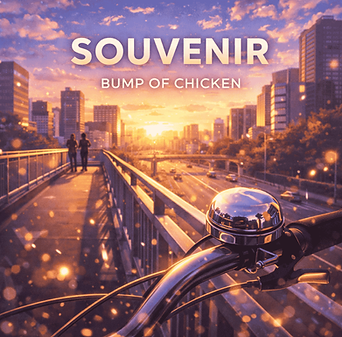
This article offers cultural and emotional commentary on selected lyric excerpts, focusing on meaning, nuance, and context rather than literal translation.
Only short excerpts are quoted for commentary purposes; full lyrics are not provided, and all rights belong to the respective rights holders.
🎁 SOUVENIR by BUMP OF CHICKEN
— Japanese Lyric Cultural & Language Room —
Released digitally in 2022, "SOUVENIR" (the opening theme for the second cour of the anime SPY×FAMILY) is a song that truly represents the essence of BUMP OF CHICKEN.
In creating this song, Motoo Fujiwa resonated with the way the story's protagonists live their ordinary lives to the fullest. He wove together the theme: "It is because there is a destination (a place to return to) that the journey itself begins to sparkle." In this song, a "souvenir" (SOUVENIR) does not merely refer to a physical gift, but to the beautiful scenery found along the way and the very time spent thinking of the other person.
Below, we deeply decode seven quintessential phrases where mundane scenes, such as pedestrian bridges and the road home, are transformed into something cherished through a kind of magic.
1. あくびの色した毎日を 丸ごと映画の様に変える 種と仕掛けに出会えた事
Romaji: akubi no iro shita mainichi o / marugoto eiga no yō ni kaeru / tane to shikake ni deaeta koto
Cultural Nuance: I encountered the "magic tricks" that transform my dull, yawn-colored days entirely into something like a cinematic masterpiece.
🗣 Japanese Insight In Japanese magic and prestidigitation, there is a famous idiomatic phrase: "Tane mo shikake mo nai" (種も仕掛けもない). Literally meaning "There are no seeds (secrets) and no mechanics," it is a set phrase used by magicians to emphasize that there is no deception or hidden gimmick behind a miracle. This lyric brilliantly and paradoxically states that there was a "seed and mechanic" (tane to shikake). The days "colored by yawns"—a metaphor for dull, monotonous, and uninspired repetition—did not change by mere coincidence. They were transformed because of the "magic seed" of meeting you. By utilizing terminology from magic, Fujiwara vividly expresses the ecstatic joy of turning a boring life into a cinematic masterpiece.
2. 仲良くなれない空の下 心はしまって鍵かけて
Romaji: nakayoku narenai sora no shita / kokoro wa shimatte kagi kakete
Cultural Nuance: I have lived protecting myself by locking away my heart within a world I couldn't fit into.
🗣 Japanese Insight The expression "a sky I couldn't befriend" (nakayoku narenai sora) serves as a metaphor for a profound sense of social alienation. It depicts a state of solitude where one feels they have no choice but to "lock" their heart to protect it from being wounded by others. While this mirrors the secret, lonely backgrounds of the anime characters, it also resonates with the universal feeling of being an outsider. This frozen, closed world only begins to move when a new "melody" (the encounter) overlaps with the protagonist's silence.
3. この目が選んだ景色に ひとつずつリボンかけて お土産みたいに集めながら続くよ 帰り道
Romaji: kono me ga eranda keshiki ni / hitotsu zutsu ribon kakete / omiyage mitai ni atsumenagara tsuzuku yo / kaerimichi
Cultural Nuance: The road home continues as I gather each view my eyes have chosen, wrapping them in ribbons like souvenirs.
🗣 Japanese Insight Here, the essence of the title "SOUVENIR" (Omiyage) is revealed. It is important to note a significant cultural difference: in many Western cultures, a "souvenir" is primarily a memento one purchases for oneself to remember a journey. However, the Japanese culture of "Omiyage" (お土産) is fundamentally outward-looking; it is about buying things specifically to share or distribute to others. The "souvenir" in this song refers to the time spent thinking of "that person" while on the road. Wrapping a view with a "ribbon" signifies a proactive will to find beauty in the world specifically for the sake of a loved one.
4. どこからどんな旅をして 見つけ合う事が出来たの あなたの昨日も明日も知らないまま 帰り道
Romaji: doko kara donna tabi o shite / mitsukeau koto ga dekita no / anata no kinō mo ashita mo shiranai mama / kaerimichi
Cultural Nuance: I wonder what kind of journeys brought us together. I still know nothing of your past or future, yet here we are with a place to return to together.
🗣 Japanese Insight The poignant phrase "Not knowing your yesterday or tomorrow" (kinō mo ashita mo shiranai mama) captures the mysterious yet pure "now" of the relationship. It highlights the miracle that, despite not knowing the details of each other's hidden pasts or the uncertain destiny of their futures, they managed to find one another at this exact point in time. It depicts a warm, bittersweet resolve to treasure the present based on the truth of the person standing before them, rather than the "biographical facts" or secrets they might carry from their past.
5. 月より遠い世界から辿ってきた 帰り道
Romaji: tsuki yori tōi sekai kara tadotte kita / kaerimichi
Cultural Nuance: I have finally reached this road home from a place so lonely and alien that it felt further than the moon.
🗣 Japanese Insight In BUMP OF CHICKEN's lyrical universe, the phrase "further than the moon" (tsuki yori tōi) is a recurring motif representing psychological isolation rather than physical distance. Just as the members of the Forger family arrived from separate, lonely worlds (the battlefields and secret missions) that were never meant to intersect, every human being carries their own unique solitude. The song captures the immense relief of finally discovering a "road home" to be shared, after a long and agonizing journey from such a desolate and distant place of the soul.
6. どこからどんな旅をして 見つけ合う事が出来たの あなたの昨日と明日が空を飾る 帰り道
Romaji: doko kara donna tabi o shite / mitsukeau koto ga dekita no / anata no kinō to ashita ga sora o kazaru / kaerimichi
Cultural Nuance: Through what kind of journey did we find each other? Your past and future, which I once couldn't have known, now beautifully color the sky of this road home.
🗣 Japanese Insight There is a crucial evolution here from phrase 4. While the partner's "yesterday and tomorrow" were previously something "unknown" (shiranai mama), they are now transformed into the radiant and affirmative expression "decorating the sky" (sora o kazaru). This change signifies that as they spend time together, the partner's background—every struggle of their past and hope for their future—has become a beloved element that colors the protagonist's own world. The once-unknown life of another is finally accepted as a beautiful "view" to be cherished.
7. この目が選んだ景色に とびきりのリボンかけて 宇宙の果てからだろうと辿っていく 帰り道
Romaji: kono me ga eranda keshiki ni / tobikiri no ribon kakete / uchū no hate kara darō to tadoritte iku / kaerimichi
Cultural Nuance: Wrapping the finest views with a special ribbon, I will always find my way back to where you are, even if I must come from the edge of the universe.
🗣 Japanese Insight In this final refrain, the ribbon is upgraded from a simple one to a "top-tier ribbon" (tobikiri no ribon). This linguistic escalation shows that as the journey nears its end and feelings deepen, the value of the "souvenirs" being brought back has reached its peak. By invoking the "edge of the universe" (uchū no hate), the ultimate symbol of distance and cosmic loneliness in BUMP's discography, the song concludes with an unbreakable vow: as long as "you" are the destination, no amount of distance can stop the journey.
🎤 Emotional Summary
BUMP OF CHICKEN's "SOUVENIR" is a song that breathes life into the profound kindness inherent in the Japanese word "Omiyage"—the act of holding someone in your heart even when apart.
Instead of a souvenir bought for oneself, it is about collecting the beauty of the world for someone else, wrapping them in ribbons, and bringing them home. This story of the "road home" is a grand anthem for every soul that has found a precious place—and a precious person—to return to.
🔍Related Articles
🥜 ミックスナッツ Mixed Nuts by Official HIGE DANdism
🏠 喜劇 Kigeki - Comedy by Gen Hoshino
🌹 トドメの一撃 Todome no Ichigeki by Vaundy feat. Cory Wong
📝 Q&A for "SOUVENIR" by BUMP OF CHICKEN
🎁 Q1. Why is the distinction between "Souvenir" and "Omiyage" so important here?
A: This is the lyrical heart of the song. While "Souvenir" often implies a memento for oneself, the Japanese "Omiyage" (お土産) is a gift bought while thinking of someone else. By titling the song "SOUVENIR" but describing the act of "wrapping the view in a ribbon" (ribon kakete), Fujiwara suggests that love is the act of looking at the world and thinking, "I want to show this beautiful sight to you." It transforms the lonely act of commuting into a proactive mission of gathering "mental gifts" for the person waiting at home.
🚪 Q2. What is the emotional shift from "Not knowing" to "Decorating the sky"?
A: In the beginning (Phrase ④), the protagonist accepts the partner without knowing their "Yesterday or Tomorrow" (shiranai mama)—a beautiful acceptance of the present. However, by the end (Phrase ⑥), those unknown pasts and futures are said to "decorate the sky" (sora o kazaru). This signifies Deepening Intimacy. Even the scars of a partner's past (their "Yesterday") and the anxieties of their future ("Tomorrow") are no longer scary mysteries; they have become part of the beautiful "scenery" that makes that person who they are.
🚀 Q3. What does "Further than the Moon" (Tsuki yori tōi) represent in BUMP's universe?
A: For BUMP OF CHICKEN, distance is often a metaphor for Psychological Isolation. "The Moon" is a recurring symbol of a place where one is observed but unreachable. To come from a place "further than the moon" means the characters (like Loid, Yor, or Anya) have lived in such profound, "top-secret" solitude that joining a family feels like traveling across the entire universe. The "Road Home" (Kaerimichi) isn't just a physical path; it’s the miraculous bridge that connects these once-distant, lonely planets.
📘 Notes on Cultural & Emotional Context
This section explores selected phrases from the song to highlight their emotional nuance and cultural background within Japanese music and storytelling.
Rather than presenting a word-for-word translation, the focus is on how these expressions convey feeling, atmosphere, and narrative meaning.
The insights are intended for readers interested in Japanese songs, anime, and culture, offering interpretive context rather than formal language instruction.
📜 Disclaimer
This article provides cultural and emotional commentary on selected lyric excerpts for informational purposes.
Only short excerpts are quoted for commentary; full lyrics are not provided.
All rights belong to the respective rights holders, and no ownership is claimed.
Advertisements or affiliate links may appear to support the site.
If you enjoyed this article, feel free to leave a comment below👇
You’re also welcome to share your thoughts or request songs you’d like us to explore in the future😊