


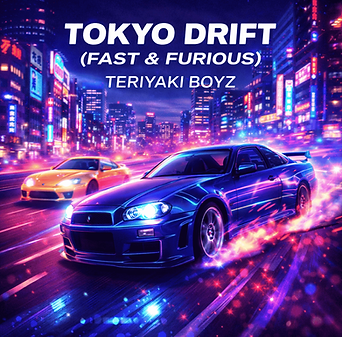
This article offers cultural and emotional commentary on selected lyric excerpts, focusing on meaning, nuance, and context rather than literal translation.
Only short excerpts are quoted for commentary purposes; full lyrics are not provided, and all rights belong to the respective rights holders.
🏎️ TOKYO DRIFT (FAST & FURIOUS) by TERIYAKI BOYZ
— Japanese Lyric Cultural & Language Room —
In 2006, a single track shook the world as the theme for the film The Fast and the Furious: Tokyo Drift: "TOKYO DRIFT (FAST & FURIOUS)" by TERIYAKI BOYZ (ILMARI, RYO-Z, VERBAL, and WISE).
The track was produced by The Neptunes, the powerhouse duo led by Pharrell Williams (who later dominated the world with "Happy" in 2013). Its creative beat, featuring oriental synth sounds and heavy bass, perfectly captures the neon-lit streets and the feverish midnight car culture of Tokyo’s Roppongi and Shibuya districts.
Furthermore, since 2020, the "TOKYO DRIFT FREESTYLE" challenge—sparked by Rich Brian of the label 88rising—has gone viral globally. With top-tier Japanese artists like Awich and JP THE WAVY joining in, this track has reclaimed its throne as the definitive anthem of Asian hip-hop, nearly two decades after its original release.
You can also enjoy this song as a YouTube slideshow. Feel free to check it out.
▶︎TERIYAKI BOYZ - TOKYO DRIFT (FAST & FURIOUS) | Meaning Behind Tokyo Drift Movie
In this article, we explore seven culturally rich phrases from the Japanese lyrics, including their romaji pronunciation, cultural context, and linguistic nuances for English speakers. Interpretations may vary.
1. Hey, へいらっしゃい おまちどうさま 喧騒まみれこの街の演奏
Romaji: Hey, hei rasshai / omachidōsama / kensō mamire kono machi no ensō
Cultural Nuance: "Welcome! Sorry for the wait. Please enjoy the symphony of this city, covered in its chaotic noise (Kensō)."
🗣 Japanese Insight The song kicks off with "Hei rasshai" and "Omachidōsama"—spirited, traditional greetings used by staff at Japanese sushi bars or ramen shops to welcome customers. The Teriyaki Boyz position themselves as the "hosts" of the Tokyo streets, welcoming global listeners with Japanese hospitality (Omotenashi).
The word "Kensō" (喧騒) refers to the loud, bustling din of voices and city sounds. Here, the "performance" (Ensō) he refers to isn't just the music, but the city's chaotic heartbeat itself—where exhaust notes and urban noise harmonize into a masterpiece.
2. 熱望ズヒル木六本
Romaji: netsubō zuhiru giroppon
Cultural Nuance: An obsessive desire to dominate the high life of Roppongi Hills and the legendary nightlife of "Giroppon" (Roppongi).
🗣 Japanese Insight This line utilizes technical "industry slang" and Zūja-go (backwards slang). "Zuhiru" is a reversal of "Hills" (Hill-zu), referring to Roppongi Hills, a luxury complex symbolizing success. "Giroppon" is the slang reversal of Roppongi, the heart of Tokyo’s nightlife. By using these playful, insider terms for the city's most prestigious spots, they assert their status as street-smart elites who own the night.
3. 忍者風、賢者風だけど芸者 (Wah) BAPEの惑星からの使者
Romaji: ninja-fū / kenja-fū dakedo geisha / BAPE no wakusei kara no shisha
Cultural Nuance: We have the speed of Ninjas and the wisdom of Sages, but at our core, we are performers (Geisha). We are messengers from "BAPE," the brand that conquered the world from Harajuku.
🗣 Japanese Insight This line creates a rhythmic rhyme using iconic Japanese figures: Ninja, Kenja (Sage), and Geisha. Their philosophy is that they aren't just warriors (Ninja), but masters of their craft—performers (Geisha, which literally translates to "person of the arts").
Additionally, A Bathing Ape (BAPE) is the world-famous streetwear brand founded in Harajuku in 1993 by the group’s producer, NIGO®. Known for its "Ape Head" logo inspired by Planet of the Apes and its iconic camo patterns, the brand represents the peak of "Ura-Harajuku" culture. Here, they overlap their identity with the brand's global invasion.
4. Like a 公安九課 トグサ マテバ 良い是非即採用
Romaji: like a kōan kyūka Togusa / Mateba yoi zehi soku saiyō
Cultural Nuance: Just like Togusa from Section 9, I have that "old-school" artisan spirit and real-world skill. I’m the kind of pro who gets hired on the spot!
🗣 Japanese Insight This is a deep homage to the world-renowned anime Ghost in the Shell. In "Public Security Section 9" (Kōan Kyūka), the character Togusa is unique because he remains mostly human (low cybernetic body-count) and insists on using an un-modernized Mateba revolver.
This lyric celebrates the "artisan spirit"—valuing someone who possesses analog skills and human intuition in a high-tech world. It’s a sophisticated metaphor by VERBAL, likening their rap mastery to a highly skilled professional being "hired on the spot" (Soku Saiyō) by the elite Chief Aramaki.
5. ホラ hands up, ファレルが bomb落とすと
Romaji: hora hands up / Fareru ga bomb otosu to
Cultural Nuance: Look, put your hands up! When Pharrell drops this fire "bomb" (beat), the whole night explodes.
🗣 Japanese Insight "Hora" is a Japanese exclamation used to grab someone's attention (like "Look!" or "See!"). By calling out Pharrell, the group highlights their connection to global greatness. In hip-hop, "dropping a bomb" refers to releasing an incredible track. This line captures the electric moment where Tokyo’s talent and a global "bomb" of a beat collide.
6. ヒートアイランド"とびとび"で 萌える容姿で『ぼちぼちねぇ~」
Romaji: hiito airando "tobitobi" de / moeru yōshi de "bochi bochi nē"
Cultural Nuance: Moving nimbly through the city’s sweltering heat; even with a look that makes the world swoon, I’ll just coolly say, "I'm doing okay."
🗣 Japanese Insight This section features unique Japanese onomatopoeia:
Tobitobi (とびとび): Describes something scattered or happening at intervals. Here, it depicts moving lightly through the "Heat Island" gaps of the concrete jungle.
Bochi bochi (ぼちぼち): A humble phrase from Kansai dialect meaning "so-so," "alright," or "slowly but surely."
Despite having an appearance that causes "Moeru" (a term from Otaku culture meaning intense attraction/crush) on a global stage, the response is a humble, laid-back "Bochi bochi." This "effortless cool" (Iki) is ILMARI’s signature style.
7. めっちゃ変わり者でもシャッフル ごちゃごちゃの Fast and Furious
Romaji: meccha kawarimono demo shaffuru / gochagocha no Fast and Furious
Cultural Nuance: Even the total eccentrics are shuffled together in this city. This messy, chaotic state is exactly what a "Fast and Furious" life is all about.
🗣 Japanese Insight "Meccha" (めっちゃ) is a strong intensifier for "extremely," and "Gochagocha" (ごちゃごちゃ) describes a state that is cluttered, messy, or overwhelming. It’s the perfect word for the sensory overload of Tokyo where races, cultures, and values collide. No matter how much of a "Kawarimono" (eccentric/weirdo) you are, you are part of the "Shuffle" in the Tokyo vortex. It’s a brilliant closing that ties the film’s title to the chaotic essence of the city itself.
🎤 Emotional Summary
"TOKYO DRIFT" is more than a movie theme; it is a "Sonic Passport" that vacuum-sealed the energy of mid-2000s Tokyo and launched it at the world.
From the greetings of a sushi shop to cyberpunk anime, Harajuku fashion, and the humble slang of the Kansai region—all of it is "drifted" over Pharrell’s mechanical beat. This track never fades because it captures the true, "cluttered" charm of Tokyo without ever faking its identity.
🔍Related Articles
💪 Bling-Bang-Bang-Born by Creepy Nuts
📝 Q&A for "TOKYO DRIFT" by TERIYAKI BOYZ
🏎️ Q1. Why does a global Hip-Hop track start with "Hei rasshai" (寿司屋の掛け声)?
A: This is a brilliant display of "Hospitality Hip-Hop." Usually, rappers start with aggressive boasts. However, TERIYAKI BOYZ choose to play the role of the "host" of Tokyo. By using "Hei rasshai" (へいらっしゃい) and "Omachidōsama" (おまちどうさま - Sorry to keep you waiting), they are inviting the global audience into their "shop" (the city of Tokyo). It frames the entire song not just as music, but as a high-speed tour of Japanese culture, served fresh like a plate of high-end sushi.
🗼 Q2. What is the cultural weight of "Zuhiru" and "Giroppon" in the lyrics?
A: These are examples of "Zūja-go" (ズージャ語)—a type of backwards slang famously used by jazz musicians and media professionals in the 80s and 90s. "Zuhiru" (Hills-zu / Roppongi Hills) and "Giroppon" (Roppongi) represent the Zenith of Tokyo's bubble-era luxury. By using this specific "industry talk," the group signals that they are "insiders" who know the hidden codes of the city's most expensive nightlife. It’s a way of saying, "We don't just visit Tokyo; we own the keys to the penthouse."
🔫 Q3. Why is the reference to "Togusa" from Ghost in the Shell so significant?
A: This is a shout-out to the "Artisan Spirit" (Shokunin Kishitsu). In the cyberpunk world of Ghost in the Shell, most characters are heavily cybernetic, but Togusa stays mostly human and uses an old Mateba revolver. VERBAL uses this to describe his rap style: he doesn't need "auto-tune" or gimmicks; he relies on raw, "analog" skill. In a high-tech city like Tokyo, the song argues that the most valuable person is the one with the human intuition and talent to be "Soku Saiyō" (即採用 - Hired on the spot) by the elite.
📘 Notes on Cultural & Emotional Context
This section explores selected phrases from the song to highlight their emotional nuance and cultural background within Japanese music and storytelling.
Rather than presenting a word-for-word translation, the focus is on how these expressions convey feeling, atmosphere, and narrative meaning.
The insights are intended for readers interested in Japanese songs, anime, and culture, offering interpretive context rather than formal language instruction.
📜 Disclaimer
This article provides cultural and emotional commentary on selected lyric excerpts for informational purposes.
Only short excerpts are quoted for commentary; full lyrics are not provided.
All rights belong to the respective rights holders, and no ownership is claimed.
Advertisements or affiliate links may appear to support the site.
If you enjoyed this article, feel free to leave a comment below👇
You’re also welcome to share your thoughts or request songs you’d like us to explore in the future😊